Ch. 4 - Probability
Triola - Elementary Statistics 14th Edition
Triola14th EditionElementary StatisticsISBN: 9780137366446Not the one you use?Change textbook
Chapter 4, Problem 4.1.29

In Exercises 29–32, use the given sample space or construct the required sample space to find the indicated probability.


Three Children Use this sample space listing the eight simple events that are possible when a couple has three children (as in Example 2): {bbb, bbg, bgb, bgg, gbb, gbg, ggb, ggg}. Assume that boys and girls are equally likely, so that the eight simple events are equally likely. Find the probability that when a couple has three children, there is exactly one girl.

Verified step by step guidance
1
Step 1: Understand the problem. The sample space provided lists all possible outcomes when a couple has three children: {bbb, bbg, bgb, bgg, gbb, gbg, ggb, ggg}. Each outcome represents the gender of the children, where 'b' stands for boy and 'g' stands for girl. We are tasked with finding the probability of having exactly one girl.
Step 2: Identify the outcomes in the sample space that meet the condition of having exactly one girl. To do this, look for outcomes where there is one 'g' (girl) and two 'b's (boys). These outcomes are: {bbg, bgb, gbb}.
Step 3: Count the total number of outcomes in the sample space. The sample space contains 8 outcomes: {bbb, bbg, bgb, bgg, gbb, gbg, ggb, ggg}.
Step 4: Count the number of favorable outcomes. From Step 2, we identified 3 outcomes that satisfy the condition of having exactly one girl: {bbg, bgb, gbb}.
Step 5: Calculate the probability. Since all outcomes are equally likely, the probability of an event is given by the formula: P(Event) = (Number of favorable outcomes) / (Total number of outcomes). Substitute the values from Steps 3 and 4 into this formula to find the probability.

Verified video answer for a similar problem:

This video solution was recommended by our tutors as helpful for the problem above.
Video duration:
2m
Was this helpful?

Key Concepts

Here are the essential concepts you must grasp in order to answer the question correctly.

Sample Space

A sample space is the set of all possible outcomes of a random experiment. In this context, the sample space consists of all combinations of boys (b) and girls (g) when a couple has three children. For this scenario, the sample space is represented as {bbb, bbg, bgb, bgg, gbb, gbg, ggb, ggg}, which includes eight distinct outcomes.
Recommended video:
05:11
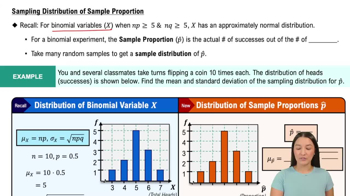
Sampling Distribution of Sample Proportion

Equally Likely Outcomes

Equally likely outcomes refer to situations where each outcome in a sample space has the same probability of occurring. In this problem, since boys and girls are assumed to be equally likely, each of the eight outcomes in the sample space has a probability of 1/8. This uniformity simplifies the calculation of probabilities for specific events.
Recommended video:
Guided course
06:00
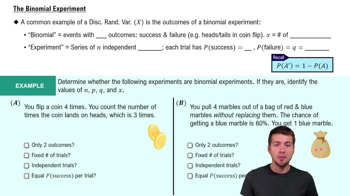
The Binomial Experiment

Probability of an Event

The probability of an event is calculated as the number of favorable outcomes divided by the total number of possible outcomes in the sample space. To find the probability of having exactly one girl among three children, we identify the favorable outcomes (bbg, bgb, gbb) and divide this by the total outcomes (8), resulting in a probability of 3/8.
Recommended video:
05:54
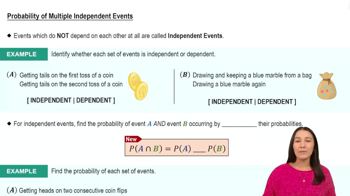
Probability of Multiple Independent Events
Related Practice
Textbook Question

In Exercises 13–20, express the indicated degree of likelihood as a probability value between 0 and 1.


Movies Based on a study of the movies made in a recent year, 33 out of every 100 movies have a female lead or co-lead.

119
views

Textbook Question

Simulating Dice When two dice are rolled, the total is between 2 and 12 inclusive. A student simulates the rolling of two dice by randomly generating numbers between 2 and 12. Does this simulation behave in a way that is similar to actual dice? Why or why not?

246
views
Textbook Question

In Exercises 33–40, use the given probability value to determine whether the sample results are significant.


Selfie Deaths Based on Priceonomics data describing 49 deaths while taking selfies, it was found that 37 of those deaths were males. Assuming that males and females are equally likely to have selfie deaths, there is a 0.000235 probability of getting 37 or more males. Is the result of 37 males significantly low, significantly high, or neither? Does the result suggest that male selfie deaths are more likely than female selfie deaths?

126
views
Textbook Question

In Exercises 9–12, assume that 100 births are randomly selected. Use subjective judgment to describe the given number of girls as (a) significantly low, (b) significantly high, or (c) neither significantly low nor significantly high.


53 girls.

126
views
Textbook Question

In Exercises 29–32, use the given sample space or construct the required sample space to find the indicated probability.


Four Children Exercise 29 lists the sample space for a couple having three children. After identifying the sample space for a couple having four children, find the probability of getting three girls and one boy (in any order).

197
views
Textbook Question

Teed Off When four golfers are about to begin a game, they often toss a tee to randomly select the order in which they tee off. What is the probability that they tee off in alphabetical order by last name?

122
views