
Ch. 4 - Probability
Triola - Elementary Statistics 14th Edition
Triola14th EditionElementary StatisticsISBN: 9780137366446Not the one you use?Change textbook
Chapter 4, Problem 4.1.40

In Exercises 33–40, use the given probability value to determine whether the sample results are significant.


Selfie Deaths Based on Priceonomics data describing 49 deaths while taking selfies, it was found that 37 of those deaths were males. Assuming that males and females are equally likely to have selfie deaths, there is a 0.000235 probability of getting 37 or more males. Is the result of 37 males significantly low, significantly high, or neither? Does the result suggest that male selfie deaths are more likely than female selfie deaths?

Verified step by step guidance
1
Step 1: Understand the problem. The question asks whether the observed result (37 male selfie deaths out of 49 total deaths) is statistically significant, given the probability of observing 37 or more males is 0.000235. This involves comparing the given probability to a significance threshold (commonly 0.05 or 0.01).
Step 2: Recall the concept of statistical significance. A result is considered statistically significant if the probability of observing it (or something more extreme) is less than the chosen significance level (e.g., 0.05). This means the result is unlikely to occur by random chance alone.
Step 3: Compare the given probability (0.000235) to the typical significance level (e.g., 0.05). If the probability is less than the significance level, the result is considered statistically significant. If it is greater, the result is not significant.
Step 4: Interpret the significance. If the result is statistically significant, it suggests that the observed number of male selfie deaths is not due to random chance and may indicate a real difference in the likelihood of selfie deaths between males and females.
Step 5: Address the second part of the question. If the result is statistically significant, it supports the idea that male selfie deaths are more likely than female selfie deaths. If not, the data does not provide strong evidence to support this claim.

Verified video answer for a similar problem:

This video solution was recommended by our tutors as helpful for the problem above.
Video duration:
5m
Was this helpful?

Key Concepts

Here are the essential concepts you must grasp in order to answer the question correctly.

Significance Level

The significance level, often denoted as alpha (α), is a threshold used in hypothesis testing to determine whether to reject the null hypothesis. Commonly set at 0.05, it indicates the probability of making a Type I error, which is rejecting a true null hypothesis. In this context, if the probability of observing 37 or more males (0.000235) is less than the significance level, the result is considered statistically significant.
Recommended video:
Guided course
04:46
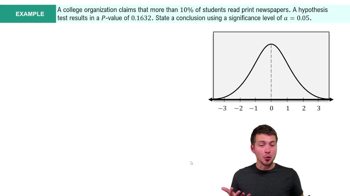
Step 4: State Conclusion Example 4

Null Hypothesis

The null hypothesis is a statement that assumes no effect or no difference in a given situation. In this case, it posits that males and females are equally likely to die while taking selfies. Testing the null hypothesis involves calculating the probability of observing the data under this assumption, which helps determine if the observed results are due to chance or indicate a real difference.
Recommended video:
Guided course
06:21
Step 1: Write Hypotheses

P-Value

The p-value is a statistical measure that helps determine the significance of the results from a hypothesis test. It represents the probability of obtaining results at least as extreme as the observed results, assuming the null hypothesis is true. A low p-value (typically less than 0.05) suggests that the observed data is unlikely under the null hypothesis, leading to the conclusion that the results are statistically significant.
Recommended video:
Guided course
06:50
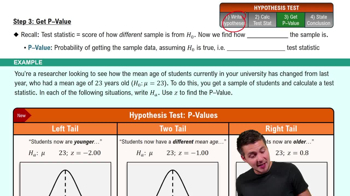
Step 3: Get P-Value
Related Practice
Textbook Question

In Exercises 29–32, use the given sample space or construct the required sample space to find the indicated probability.


Three Children Use this sample space listing the eight simple events that are possible when a couple has three children (as in Example 2): {bbb, bbg, bgb, bgg, gbb, gbg, ggb, ggg}. Assume that boys and girls are equally likely, so that the eight simple events are equally likely. Find the probability that when a couple has three children, there is exactly one girl.

155
views
Textbook Question

In Exercises 9–20, use the data in the following table, which lists survey results from high school drivers at least 16 years of age (based on data from “Texting While Driving and Other Risky Motor Vehicle Behaviors Among U.S. High School Students,” by O’Malley, Shults, and Eaton, Pediatrics, Vol. 131, No. 6). Assume that subjects are randomly selected from those included in the table. Hint: Be very careful to read the question correctly.

Drinking and Driving If one of the high school drivers is randomly selected, find the probability of getting one who drove when drinking alcohol.

97
views
Textbook Question

Same Birthdays If 25 people are randomly selected, find the probability that no 2 of them have the same birthday. Ignore leap years.

214
views
Textbook Question

Simulating Dice When two dice are rolled, the total is between 2 and 12 inclusive. A student simulates the rolling of two dice by randomly generating numbers between 2 and 12. Does this simulation behave in a way that is similar to actual dice? Why or why not?

246
views
Textbook Question

In Exercises 33–40, use the given probability value to determine whether the sample results are significant.


Voting Repeat Exercise 33 after replacing 40 Democrats being placed on the first line of voting ballots with 27 Democrats being placed on the first line. The probability of getting a result as high as 27 is 0.029792.

103
views
Textbook Question

In Exercises 9–12, assume that 100 births are randomly selected. Use subjective judgment to describe the given number of girls as (a) significantly low, (b) significantly high, or (c) neither significantly low nor significantly high.


53 girls.

126
views