Ch. 4 - Probability
Triola - Elementary Statistics 14th Edition
Triola14th EditionElementary StatisticsISBN: 9780137366446Not the one you use?Change textbook
Chapter 4, Problem 4.2.2

Notation When randomly selecting adults, let M denote the event of randomly selecting a male and let B denote the event of randomly selecting someone with blue eyes. What does P (M|B) represent? Is P (M|B) the same as P (B|M)?

Verified step by step guidance
1
Step 1: Understand the notation P(M|B). This represents the conditional probability of event M (selecting a male) given that event B (selecting someone with blue eyes) has already occurred. Mathematically, it is expressed as P(M|B) = P(M ∩ B) / P(B), where P(M ∩ B) is the probability of both events M and B occurring, and P(B) is the probability of event B.
Step 2: Understand the notation P(B|M). This represents the conditional probability of event B (selecting someone with blue eyes) given that event M (selecting a male) has already occurred. Mathematically, it is expressed as P(B|M) = P(M ∩ B) / P(M), where P(M ∩ B) is the probability of both events M and B occurring, and P(M) is the probability of event M.
Step 3: Compare P(M|B) and P(B|M). These two probabilities are not necessarily the same because they depend on different conditions. P(M|B) is conditioned on the event of selecting someone with blue eyes, while P(B|M) is conditioned on the event of selecting a male. The denominators in their formulas, P(B) and P(M), are generally different unless the probabilities of these events are equal.
Step 4: Recognize the importance of the joint probability P(M ∩ B). Both P(M|B) and P(B|M) share the same numerator, which is the joint probability of selecting a male with blue eyes. However, the difference lies in the denominator, which changes based on the given condition.
Step 5: Conclude that P(M|B) and P(B|M) are not the same in general. They represent different conditional probabilities and depend on the specific probabilities of the events M and B. To determine their values, you would need the probabilities P(M), P(B), and P(M ∩ B).

Verified video answer for a similar problem:

This video solution was recommended by our tutors as helpful for the problem above.
Video duration:
3m
Was this helpful?

Key Concepts

Here are the essential concepts you must grasp in order to answer the question correctly.

Conditional Probability

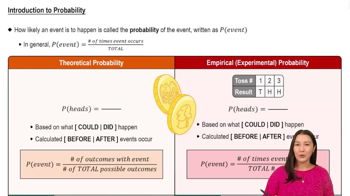
Conditional probability refers to the likelihood of an event occurring given that another event has already occurred. It is denoted as P(A|B), which reads as 'the probability of A given B.' In this context, P(M|B) represents the probability of selecting a male given that the individual has blue eyes.
Recommended video:
5:37
Introduction to Probability

Bayes' Theorem

Bayes' Theorem is a fundamental principle in probability that describes how to update the probability of a hypothesis based on new evidence. It relates the conditional probabilities of two events and is expressed as P(A|B) = [P(B|A) * P(A)] / P(B). This theorem helps in understanding the relationship between P(M|B) and P(B|M).

Independence of Events

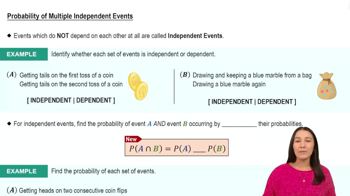
Two events are considered independent if the occurrence of one does not affect the probability of the other. In this case, if M and B are independent, then P(M|B) would equal P(M), and P(B|M) would equal P(B). Understanding whether M and B are independent is crucial for determining if P(M|B) is the same as P(B|M).
Recommended video:
05:54
Probability of Multiple Independent Events
Related Practice
Textbook Question

Social Security Numbers A Social Security number consists of nine digits in a particular order, and repetition of digits is allowed. After seeing the last four digits printed on a receipt, if you randomly select the other digits, what is the probability of getting the correct Social Security number of the person who was given the receipt?

278
views
Textbook Question

In Exercises 9–12, assume that 100 births are randomly selected. Use subjective judgment to describe the given number of girls as (a) significantly low, (b) significantly high, or (c) neither significantly low nor significantly high.


75 girls.

118
views
Textbook Question

Radio Station Call Letters Radio and Television station call letters must begin with either K (for stations west of the Mississippi River) or W (for stations east of the Mississippi River) and must include either two or three additional letters. How many different possibilities are there?

152
views
Textbook Question

ZIP Code If you randomly select five digits, each between 0 and 9, with repetition allowed, what is the probability you will get the author’s ZIP code?

147
views
Textbook Question

In Exercises 33–40, use the given probability value to determine whether the sample results are significant.


Voting Repeat Exercise 33 after replacing 40 Democrats being placed on the first line of voting ballots with 14 Democrats being placed on the first line. The probability of getting a result as low as 14 is 0.029792.

101
views
Textbook Question

Subjective Probability Estimate the probability that the next time that you approach an escalator, you find it to be in operation.

139
views