Ch. 4 - Probability
Triola - Elementary Statistics 14th Edition
Triola14th EditionElementary StatisticsISBN: 9780137366446Not the one you use?Change textbook
Chapter 4, Problem 4.4.19

ZIP Code If you randomly select five digits, each between 0 and 9, with repetition allowed, what is the probability you will get the author’s ZIP code?

Verified step by step guidance
1
Step 1: Understand the problem. You are tasked with calculating the probability of randomly selecting a specific ZIP code, which consists of five digits. Each digit can range from 0 to 9, and repetition is allowed.
Step 2: Determine the total number of possible outcomes. Since there are 10 possible digits (0 through 9) for each of the five positions in the ZIP code, the total number of combinations is calculated as \( 10^5 \). This represents all possible five-digit combinations.
Step 3: Identify the number of favorable outcomes. There is only one specific ZIP code that matches the author's ZIP code, so the number of favorable outcomes is 1.
Step 4: Calculate the probability. The probability of selecting the author's ZIP code is the ratio of favorable outcomes to total outcomes, expressed as \( P = \frac{1}{10^5} \).
Step 5: Simplify the probability expression if needed. The probability can be left in its fractional form or converted to a decimal for interpretation, but the calculation stops here without evaluating the final numerical result.

Verified video answer for a similar problem:

This video solution was recommended by our tutors as helpful for the problem above.
Video duration:
2m
Was this helpful?

Key Concepts

Here are the essential concepts you must grasp in order to answer the question correctly.

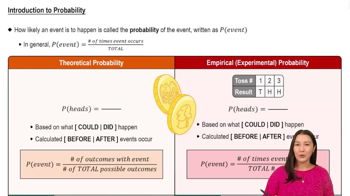
Probability

Probability is a measure of the likelihood that a particular event will occur, expressed as a number between 0 and 1. In this context, it quantifies the chance of randomly selecting a specific five-digit ZIP code from all possible combinations of digits. Understanding probability is essential for calculating the chances of obtaining the author's ZIP code when selecting digits randomly.
Recommended video:
5:37
Introduction to Probability

Combinatorics

Combinatorics is a branch of mathematics dealing with counting, arrangement, and combination of objects. In this scenario, it helps determine the total number of possible five-digit combinations that can be formed using digits 0 through 9, with repetition allowed. This total is crucial for calculating the probability of selecting the specific ZIP code.

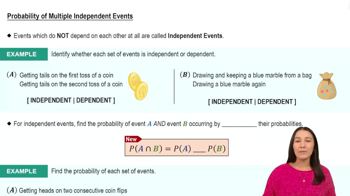
Independent Events

Independent events are outcomes where the occurrence of one event does not affect the occurrence of another. In the case of selecting digits for a ZIP code, each digit is chosen independently, meaning the choice of one digit does not influence the others. Recognizing this independence is vital for accurately calculating the overall probability of forming the author's ZIP code.
Recommended video:
05:54
Probability of Multiple Independent Events
Related Practice
Textbook Question

DNA Nucleotides DNA (deoxyribonucleic acid) is made of nucleotides. Each nucleotide can contain any one of these nitrogenous bases: A (adenine), G (guanine), C (cytosine), T (thymine). If one of those four bases (A, G, C, T) must be selected three times to form a linear triplet, how many different triplets are possible? All four bases can be selected for each of the three components of the triplet.

247
views
Textbook Question

Notation When randomly selecting adults, let M denote the event of randomly selecting a male and let B denote the event of randomly selecting someone with blue eyes. What does P (M|B) represent? Is P (M|B) the same as P (B|M)?

155
views
Textbook Question

In Exercises 9–12, assume that 100 births are randomly selected. Use subjective judgment to describe the given number of girls as (a) significantly low, (b) significantly high, or (c) neither significantly low nor significantly high.


75 girls.

118
views
Textbook Question

Radio Station Call Letters Radio and Television station call letters must begin with either K (for stations west of the Mississippi River) or W (for stations east of the Mississippi River) and must include either two or three additional letters. How many different possibilities are there?

152
views
Textbook Question

In Exercises 33–40, use the given probability value to determine whether the sample results are significant.


Voting Repeat Exercise 33 after replacing 40 Democrats being placed on the first line of voting ballots with 14 Democrats being placed on the first line. The probability of getting a result as low as 14 is 0.029792.

101
views
Textbook Question

Subjective Probability Estimate the probability that the next time that you approach an escalator, you find it to be in operation.

139
views