
Ch. 5 - Discrete Probability Distributions
Triola - Elementary Statistics 14th Edition
Triola14th EditionElementary StatisticsISBN: 9780137366446Not the one you use?Change textbook
Chapter 5, Problem 5.2.13b

Binomial Probability Formula. In Exercises 13 and 14, answer the questions designed to help understand the rationale for the binomial probability formula.


Guessing Answers Standard tests, such as the SAT, ACT, or Medical College Admission Test (MCAT), typically use multiple choice questions, each with five possible answers (a, b, c, d, e), one of which is correct. Assume that you guess the answers to the first three questions.


b. Beginning with WWC, make a complete list of the different possible arrangements of two wrong answers and one correct answer, and then find the probability for each entry in the list.

Verified step by step guidance
1
Step 1: Understand the problem. You are tasked with listing all possible arrangements of two wrong answers (W) and one correct answer (C) for three questions, and then calculating the probability for each arrangement. This involves understanding the binomial probability formula and basic combinatorics.
Step 2: List all possible arrangements of two wrong answers and one correct answer. Since there are three questions, the arrangements can be represented as permutations of the letters 'WWC'. These include: WWC, WCW, CWW. Ensure you account for all possible orders.
Step 3: Calculate the probability of each arrangement. For each question, there is a 1/5 chance of guessing correctly (C) and a 4/5 chance of guessing incorrectly (W). The probability of a specific arrangement is the product of the probabilities for each position. For example, for WWC: \( P(WWC) = \left( \frac{4}{5} \right) \times \left( \frac{4}{5} \right) \times \left( \frac{1}{5} \right) \).
Step 4: Repeat the probability calculation for each arrangement (WCW and CWW). The probabilities will be the same for all arrangements because the number of correct and wrong answers is fixed, and the positions are equally likely.
Step 5: Summarize the results. Once you have calculated the probability for each arrangement, you can confirm that the sum of probabilities across all arrangements equals the total probability of having two wrong answers and one correct answer in three questions. This is consistent with the binomial probability formula.

Verified video answer for a similar problem:

This video solution was recommended by our tutors as helpful for the problem above.
Video duration:
4m
Was this helpful?

Key Concepts

Here are the essential concepts you must grasp in order to answer the question correctly.

Binomial Probability

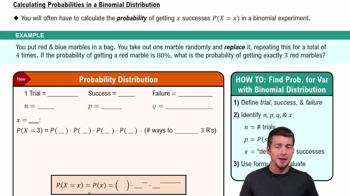
The binomial probability formula is used to calculate the likelihood of a specific number of successes in a fixed number of independent trials, each with two possible outcomes (success or failure). It is expressed as P(X = k) = (n choose k) * p^k * (1-p)^(n-k), where n is the number of trials, k is the number of successes, and p is the probability of success on a single trial.
Recommended video:
Guided course
06:39
Calculating Probabilities in a Binomial Distribution

Combinations

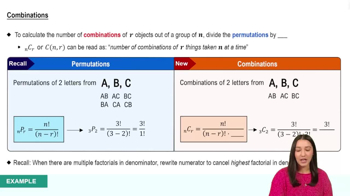
Combinations refer to the selection of items from a larger set where the order does not matter. In the context of the binomial probability formula, combinations are used to determine how many different ways a certain number of successes can occur among the trials. The formula for combinations is given by n choose k = n! / (k!(n-k)!), where n is the total number of items and k is the number of items to choose.
Recommended video:
05:22
Combinations

Probability of Events

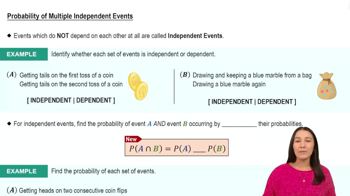
Probability quantifies the likelihood of an event occurring, ranging from 0 (impossible) to 1 (certain). In the context of guessing answers on a multiple-choice test, the probability of selecting the correct answer is 1/5, while the probability of selecting a wrong answer is 4/5. Understanding these probabilities is essential for calculating the overall probability of different outcomes when guessing answers.
Recommended video:
05:54
Probability of Multiple Independent Events
Related Practice
Textbook Question

In Exercises 29 and 30, assume that different groups of couples use the XSORT method of gender selection and each couple gives birth to one baby. The XSORT method is designed to increase the likelihood that a baby will be a girl, but assume that the method has no effect, so the probability of a girl is 0.5.


Gender Selection Assume that the groups consist of 36 couples.


b. Use the range rule of thumb to find the values separating results that are significantly low or significantly high.

91
views
Textbook Question

In Exercises 9–16, use the Poisson distribution to find the indicated probabilities.


Births In a recent year (365 days), NYU-Langone Medical Center had 5942 births.


b. Find the probability that in a single day, there are 16 births.

143
views
Textbook Question

Using Probabilities for Significant Events


b. Find the probability of getting 1 or fewer matches.

134
views
Textbook Question

 In Exercises 5–8, assume that the Poisson distribution applies; assume that the mean number of Atlantic hurricanes in the United States is 5.5 per year, as in Example 1; and proceed to find the indicated probability.


Hurricanes


b. In a 118-year period, how many years are expected to have 7 hurricanes?

100
views
Textbook Question

In Exercises 5–8, assume that the Poisson distribution applies; assume that the mean number of Atlantic hurricanes in the United States is 5.5 per year, as in Example 1; and proceed to find the indicated probability.

b. In a 118-year period, how many years are expected to have 10 hurricanes?

128
views
Textbook Question

In Exercises 31 and 32, assume that hybridization experiments are conducted with peas having the property that for offspring, there is a 0.75 probability that a pea has green pods (as in one of Mendel’s famous experiments).


Hybrids Assume that offspring peas are randomly selected in groups of 16.


b. Use the range rule of thumb to find the values separating results that are significantly low or significantly high.

198
views