
Ch. 8 - Hypothesis Testing
Triola - Elementary Statistics 14th Edition
Triola14th EditionElementary StatisticsISBN: 9780137366446Not the one you use?Change textbook
Chapter 8, Problem 8.1.13

Finding P-Values
In Exercises 13–16, do the following:


i. Identify the hypothesis test as being two-tailed, left-tailed, or right-tailed.
ii. Find the P-value. (See Figure 8-3.)
iii. Using a significance level of α = 0.05 should we reject H0 or should we fail to reject H0?


The test statistic of z = -0.75 is obtained when testing the claim that p<1/3.

Verified step by step guidance
1
Step 1: Identify the type of hypothesis test. Since the claim is that p < 1/3, this is a left-tailed test because the alternative hypothesis (H1) involves a 'less than' inequality.
Step 2: Write down the null hypothesis (H0) and the alternative hypothesis (H1). H0: p = 1/3 (the population proportion is equal to 1/3), and H1: p < 1/3 (the population proportion is less than 1/3).
Step 3: Use the given test statistic z = -0.75 to find the P-value. For a left-tailed test, the P-value is the area to the left of z = -0.75 on the standard normal distribution curve. Use a z-table or statistical software to find this area.
Step 4: Compare the P-value to the significance level α = 0.05. If the P-value is less than α, reject the null hypothesis (H0). If the P-value is greater than or equal to α, fail to reject the null hypothesis (H0).
Step 5: Based on the comparison in Step 4, make a conclusion about the hypothesis test. State whether there is sufficient evidence to support the claim that p < 1/3 at the 0.05 significance level.

Verified video answer for a similar problem:

This video solution was recommended by our tutors as helpful for the problem above.
Video duration:
3m
Was this helpful?

Key Concepts

Here are the essential concepts you must grasp in order to answer the question correctly.

Hypothesis Testing

Hypothesis testing is a statistical method used to make decisions about a population parameter based on sample data. It involves formulating two competing hypotheses: the null hypothesis (H0), which represents no effect or no difference, and the alternative hypothesis (H1), which represents the effect or difference. The goal is to determine whether there is enough evidence in the sample to reject H0 in favor of H1.
Recommended video:
Guided course
06:21
Step 1: Write Hypotheses

P-Value

The P-value is a measure that helps determine the strength of the evidence against the null hypothesis. It represents the probability of obtaining a test statistic as extreme as, or more extreme than, the observed value under the assumption that H0 is true. A smaller P-value indicates stronger evidence against H0, and it is compared to a predetermined significance level (α) to decide whether to reject H0.
Recommended video:
Guided course
06:50
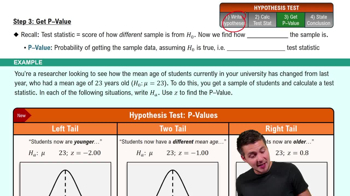
Step 3: Get P-Value

One-Tailed vs. Two-Tailed Tests

In hypothesis testing, tests can be classified as one-tailed or two-tailed based on the direction of the alternative hypothesis. A one-tailed test assesses the possibility of an effect in one direction (either greater than or less than), while a two-tailed test considers both directions. Identifying the correct type of test is crucial for accurately interpreting the P-value and making decisions regarding the null hypothesis.
Recommended video:
Guided course
06:50
Step 3: Get P-Value
Related Practice
Textbook Question

Interpreting P-value The Ericsson method is one of several methods claimed to increase the likelihood of a baby girl. In a clinical trial, results could be analyzed with a formal hypothesis test with the alternative hypothesis of p > 0.5 which corresponds to the claim that the method increases the likelihood of having a girl, so that the proportion of girls is greater than 0.5. If you have an interest in establishing the success of the method, which of the following P-values would you prefer as a result in your hypothesis test: 0.999, 0.5, 0.95, 0.05, 0.01, 0.001? Why?

188
views
Textbook Question

Type I and Type II Errors

In Exercises 25–28, provide statements that identify the type I error and the type II error that correspond to the given claim. (Although conclusions are usually expressed in verbal form, the answers here can be expressed with statements that include symbolic expressions such as p = 0.1.)


The proportion of people who write with their left hand is equal to 0.1.

129
views
Textbook Question

Interpreting Power Chantix (varenicline) tablets are used as an aid to help people stop smoking. In a clinical trial, 129 subjects were treated with Chantix twice a day for 12 weeks, and 16 subjects experienced abdominal pain (based on data from Pfizer, Inc.). If someone claims that more than 8% of Chantix users experience abdominal pain, that claim is supported with a hypothesis test conducted with a 0.05 significance level. Using 0.18 as an alternative value of p, the power of the test is 0.96. Interpret this value of the power of the test.

144
views
Textbook Question

Testing Claims About Variation

In Exercises 5–16, test the given claim. Identify the null hypothesis, alternative hypothesis, test statistic, P-value, or critical value(s), then state the conclusion about the null hypothesis, as well as the final conclusion that addresses the original claim. Assume that a simple random sample is selected from a normally distributed population.


Birth Weights A simple random sample of birth weights of 30 girls has a standard deviation of 829.5 g. Use a 0.01 significance level to test the claim that birth weights of girls have the same standard deviation as birth weights of boys, which is 660.2 g (based on Data Set 6 “Births” in Appendix B).

116
views
Textbook Question

Exact Method For each of the three different methods of hypothesis testing (identified in the left column), enter the P-values corresponding to the given alternative hypothesis and sample data. Use a 0.05 significance level. Note that the entries in the last column correspond to the Chapter Problem. How do the results agree with the large sample size?

180
views
Textbook Question

Randomization: Testing a Claim About a Mean

In Exercises 9–12, use the randomization procedure for the indicated exercise.

Section 8-3, Exercise 21 “Lead in Medicine”

112
views