
Ch. 8 - Hypothesis Testing
Triola - Elementary Statistics 14th Edition
Triola14th EditionElementary StatisticsISBN: 9780137366446Not the one you use?Change textbook
Chapter 8, Problem 8.1.3

Interpreting P-value The Ericsson method is one of several methods claimed to increase the likelihood of a baby girl. In a clinical trial, results could be analyzed with a formal hypothesis test with the alternative hypothesis of p > 0.5 which corresponds to the claim that the method increases the likelihood of having a girl, so that the proportion of girls is greater than 0.5. If you have an interest in establishing the success of the method, which of the following P-values would you prefer as a result in your hypothesis test: 0.999, 0.5, 0.95, 0.05, 0.01, 0.001? Why?

Verified step by step guidance
1
Step 1: Understand the hypothesis test setup. The null hypothesis (H₀) is p = 0.5, meaning the method does not increase the likelihood of having a girl. The alternative hypothesis (H₁) is p > 0.5, meaning the method increases the likelihood of having a girl.
Step 2: Recall the interpretation of the P-value. The P-value represents the probability of observing the sample data, or something more extreme, assuming the null hypothesis is true. A smaller P-value indicates stronger evidence against the null hypothesis.
Step 3: Determine the threshold for significance. Typically, a significance level (α) is chosen, such as 0.05. If the P-value is less than α, the null hypothesis is rejected in favor of the alternative hypothesis.
Step 4: Compare the given P-values (0.999, 0.5, 0.95, 0.05, 0.01, 0.001) to the significance level. Smaller P-values (e.g., 0.01 or 0.001) provide stronger evidence to reject the null hypothesis and support the claim that the method increases the likelihood of having a girl.
Step 5: Conclude which P-value is preferable. If you are interested in establishing the success of the method, you would prefer the smallest P-value (e.g., 0.001), as it provides the strongest evidence against the null hypothesis and supports the alternative hypothesis (p > 0.5).

Verified video answer for a similar problem:

This video solution was recommended by our tutors as helpful for the problem above.
Video duration:
4m
Was this helpful?

Key Concepts

Here are the essential concepts you must grasp in order to answer the question correctly.

P-value

The P-value is a statistical measure that helps determine the significance of results from a hypothesis test. It represents the probability of observing the test results, or something more extreme, assuming that the null hypothesis is true. A lower P-value indicates stronger evidence against the null hypothesis, suggesting that the alternative hypothesis may be more plausible.
Recommended video:
Guided course
06:50
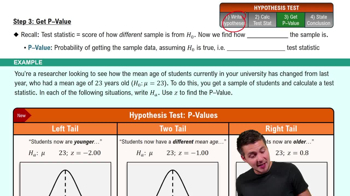
Step 3: Get P-Value

Hypothesis Testing

Hypothesis testing is a statistical method used to make inferences about population parameters based on sample data. It involves formulating a null hypothesis (typically a statement of no effect) and an alternative hypothesis (indicating the presence of an effect). The goal is to determine whether there is enough evidence in the sample data to reject the null hypothesis in favor of the alternative.
Recommended video:
Guided course
06:21
Step 1: Write Hypotheses

Significance Level

The significance level, often denoted as alpha (α), is the threshold used to determine whether a P-value indicates a statistically significant result. Commonly set at 0.05, it represents the probability of rejecting the null hypothesis when it is actually true (Type I error). A P-value less than the significance level suggests that the results are statistically significant, supporting the alternative hypothesis.
Recommended video:
Guided course
04:46
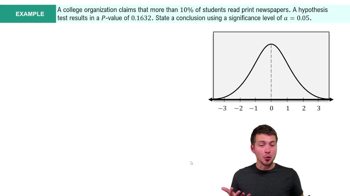
Step 4: State Conclusion Example 4
Related Practice
Textbook Question

Type I and Type II Errors

In Exercises 25–28, provide statements that identify the type I error and the type II error that correspond to the given claim. (Although conclusions are usually expressed in verbal form, the answers here can be expressed with statements that include symbolic expressions such as p = 0.1.)


The proportion of people who write with their left hand is equal to 0.1.

129
views
Textbook Question

Final Conclusions

In Exercises 21–24, use a significance level of α = 0.05 and use the given information for the following:


State a conclusion about the null hypothesis. (Reject H0 or fail to reject H0.)

Without using technical terms or symbols, state a final conclusion that addresses the original claim


Original claim: More than 35% of air travelers would choose another airline to have access to inflight Wi-Fi. The hypothesis test results in a P-value of 0.00001.

165
views
Textbook Question

Testing Claims About Variation

In Exercises 5–16, test the given claim. Identify the null hypothesis, alternative hypothesis, test statistic, P-value, or critical value(s), then state the conclusion about the null hypothesis, as well as the final conclusion that addresses the original claim. Assume that a simple random sample is selected from a normally distributed population.


Birth Weights A simple random sample of birth weights of 30 girls has a standard deviation of 829.5 g. Use a 0.01 significance level to test the claim that birth weights of girls have the same standard deviation as birth weights of boys, which is 660.2 g (based on Data Set 6 “Births” in Appendix B).

116
views
Textbook Question

Exact Method For each of the three different methods of hypothesis testing (identified in the left column), enter the P-values corresponding to the given alternative hypothesis and sample data. Use a 0.05 significance level. Note that the entries in the last column correspond to the Chapter Problem. How do the results agree with the large sample size?

180
views
Textbook Question

Finding P-Values

In Exercises 13–16, do the following:


i. Identify the hypothesis test as being two-tailed, left-tailed, or right-tailed.

ii. Find the P-value. (See Figure 8-3.)

iii. Using a significance level of α = 0.05 should we reject H0 or should we fail to reject H0?


The test statistic of z = -0.75 is obtained when testing the claim that p<1/3.

165
views
Textbook Question

Randomization: Testing a Claim About a Mean

In Exercises 9–12, use the randomization procedure for the indicated exercise.

Section 8-3, Exercise 21 “Lead in Medicine”

112
views