Ch. 8 - Hypothesis Testing
Triola - Elementary Statistics 14th Edition
Triola14th EditionElementary StatisticsISBN: 9780137366446Not the one you use?Change textbook
Chapter 8, Problem 8.2.34b

Using Confidence Intervals to Test Hypotheses When analyzing the last digits of telephone numbers in Port Jefferson, it is found that among 1000 randomly selected digits, 119 are zeros. If the digits are randomly selected, the proportion of zeros should be 0.1.


b. Use the P-value method with a 0.05 significance level to test the claim that the proportion of zeros equals 0.1.

Verified step by step guidance
1
Step 1: Define the null hypothesis (H₀) and the alternative hypothesis (H₁). The null hypothesis is H₀: p = 0.1, which states that the proportion of zeros is 0.1. The alternative hypothesis is H₁: p ≠ 0.1, which states that the proportion of zeros is not 0.1.
Step 2: Calculate the sample proportion (p̂). The sample proportion is given by p̂ = x / n, where x is the number of zeros observed (119) and n is the total number of digits sampled (1000). Substitute the values into the formula to find p̂.
Step 3: Compute the test statistic. Use the formula for the z-test for proportions: z = (p̂ - p₀) / √((p₀(1 - p₀)) / n), where p₀ is the hypothesized population proportion (0.1), p̂ is the sample proportion, and n is the sample size. Substitute the values into the formula to calculate the z-test statistic.
Step 4: Determine the P-value. Using the z-test statistic calculated in Step 3, find the P-value by looking up the corresponding value in the standard normal distribution table. Since this is a two-tailed test (H₁: p ≠ 0.1), double the area in the tail beyond the absolute value of the z-test statistic.
Step 5: Compare the P-value to the significance level (α = 0.05). If the P-value is less than or equal to 0.05, reject the null hypothesis (H₀). Otherwise, fail to reject the null hypothesis. Interpret the result in the context of the problem, stating whether there is sufficient evidence to support the claim that the proportion of zeros is not 0.1.

Verified video answer for a similar problem:

This video solution was recommended by our tutors as helpful for the problem above.
Video duration:
6m
Was this helpful?

Key Concepts

Here are the essential concepts you must grasp in order to answer the question correctly.

Hypothesis Testing

Hypothesis testing is a statistical method used to make decisions about a population based on sample data. It involves formulating a null hypothesis (H0) that represents no effect or no difference, and an alternative hypothesis (H1) that represents the effect or difference we suspect. The goal is to determine whether there is enough evidence in the sample data to reject the null hypothesis in favor of the alternative.
Recommended video:
Guided course
06:21
Step 1: Write Hypotheses

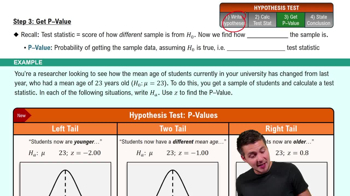
P-value

The P-value is a measure that helps determine the strength of the evidence against the null hypothesis. It represents the probability of obtaining a test statistic at least as extreme as the one observed, assuming the null hypothesis is true. A smaller P-value indicates stronger evidence against the null hypothesis, and if it is less than the significance level (e.g., 0.05), we reject the null hypothesis.
Recommended video:
Guided course
06:50
Step 3: Get P-Value

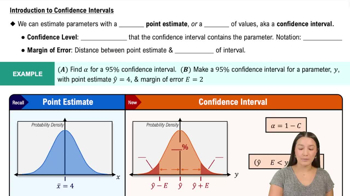
Confidence Intervals

A confidence interval is a range of values, derived from sample statistics, that is likely to contain the true population parameter with a specified level of confidence (e.g., 95%). It provides an estimate of the uncertainty around the sample proportion. In hypothesis testing, confidence intervals can be used to assess whether a hypothesized value (like 0.1 for the proportion of zeros) falls within the interval, which can inform decisions about the null hypothesis.
Recommended video:
06:33
Introduction to Confidence Intervals
Related Practice
Textbook Question

Statistical Literacy and Critical Thinking

In Exercises 1–4, use the results from a Hankook Tire Gauge Index survey of a simple random sample of 1020 adults. Among the 1020 respondents, 86% rated themselves as above average drivers. We want to test the claim that more than 3/4 of adults rate themselves as above average drivers.


Null and Alternative Hypotheses and Test Statistic


b. Find the value of the test statistic.

105
views
Textbook Question

At Least As Extreme A random sample of 860 births in New York State included 426 boys, and that sample is to be used for a test of the common belief that the proportion of male births in the population is equal to 0.512.


b. For random samples of size 860, what sample proportions of male births are at least as extreme as the sample proportion of 426/860?

127
views
Textbook Question

Statistical Literacy and Critical Thinking

In Exercises 1–4, use the results from a Hankook Tire Gauge Index survey of a simple random sample of 1020 adults. Among the 1020 respondents, 86% rated themselves as above average drivers. We want to test the claim that more than 3/4 of adults rate themselves as above average drivers.


Number and Proportions


c. For the hypothesis test, identify the value used for the population proportion and use the symbol that represents it.

111
views
Textbook Question

Lightning Deaths Listed below are the numbers of deaths from lightning strikes in the United States each year for a sequence of recent and consecutive years. Find the values of the indicated statistics.

46 51 44 51 43 32 38 48 45 27 34 29 26 28 23 26 28 40 16 20

c. standard deviation

118
views
Textbook Question

Lightning Deaths Based on the results given in Cumulative Review Exercise 6, assume that for a randomly selected lightning death, there is a 0.8 probability that the victim is a male.

a. Find the probability that three random people killed by lightning strikes are all males.

86
views
Textbook Question

Statistical Literacy and Critical Thinking

In Exercises 1–4, use the results from a Hankook Tire Gauge Index survey of a simple random sample of 1020 adults. Among the 1020 respondents, 86% rated themselves as above average drivers. We want to test the claim that more than 3/4 of adults rate themselves as above average drivers.


Number and Proportions


b. Identify the sample proportion and use the symbol that represents it.

104
views