
Ch. 9 - Inferences from Two Samples
Triola - Elementary Statistics 14th Edition
Triola14th EditionElementary StatisticsISBN: 9780137366446Not the one you use?Change textbook
Chapter 9, Problem 9.q.3a

P-VALUE The test statistic of z = 2.14 is obtained when using the data from Exercise 1 and testing the claim that patients treated with dexamethasone and patients given a placebo have the same rate of complete resolution.


a. Find the P-value for the test.

Verified step by step guidance
1
Step 1: Understand the context of the problem. The test statistic z = 2.14 is given, and we are testing the claim that there is no difference in the rate of complete resolution between two groups (dexamethasone and placebo). This is a two-tailed test because we are testing for equality (no difference).
Step 2: Recall the relationship between the z-score and the P-value. The P-value represents the probability of observing a test statistic as extreme as, or more extreme than, the observed value under the null hypothesis. For a two-tailed test, the P-value is calculated as: \( P = 2 \cdot P(Z > |z|) \), where \( Z \) follows the standard normal distribution.
Step 3: Use the standard normal distribution table (or a statistical software) to find the area to the right of \( |z| = 2.14 \). This area corresponds to \( P(Z > 2.14) \).
Step 4: Multiply the result from Step 3 by 2 to account for the two-tailed nature of the test. This gives the total P-value: \( P = 2 \cdot P(Z > 2.14) \).
Step 5: Compare the calculated P-value to the significance level (\( \alpha \)) to determine whether to reject or fail to reject the null hypothesis. If \( P < \alpha \), reject the null hypothesis; otherwise, fail to reject it.

Verified video answer for a similar problem:

This video solution was recommended by our tutors as helpful for the problem above.
Video duration:
2m
Was this helpful?

Key Concepts

Here are the essential concepts you must grasp in order to answer the question correctly.

P-Value

The P-value is a statistical measure that helps determine the significance of results from a hypothesis test. It represents the probability of obtaining a test statistic at least as extreme as the one observed, assuming the null hypothesis is true. A smaller P-value indicates stronger evidence against the null hypothesis, often leading to its rejection.
Recommended video:
Guided course
06:50
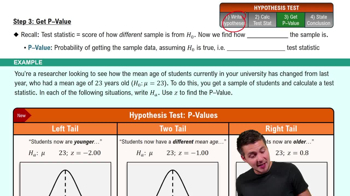
Step 3: Get P-Value

Hypothesis Testing

Hypothesis testing is a statistical method used to make inferences about population parameters based on sample data. It involves formulating a null hypothesis (H0) and an alternative hypothesis (H1), then using sample data to determine whether to reject H0. The outcome is often guided by the P-value, which indicates the strength of evidence against H0.
Recommended video:
Guided course
06:21
Step 1: Write Hypotheses

Test Statistic

A test statistic is a standardized value that is calculated from sample data during a hypothesis test. It quantifies the difference between the observed data and what is expected under the null hypothesis. In this case, a z-test statistic of 2.14 indicates how many standard deviations the sample mean is from the population mean under H0, which is crucial for calculating the P-value.
Recommended video:
Guided course
06:34
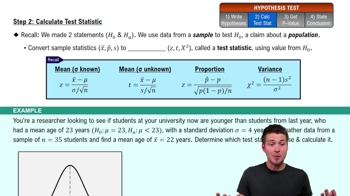
Step 2: Calculate Test Statistic
Related Practice
Textbook Question

Denomination Effect A trial was conducted with 75 women in China given a 100-yuan bill, while another 75 women in China were given 100 yuan in the form of smaller bills (a 50-yuan bill plus two 20-yuan bills plus two 5-yuan bills). Among those given the single bill, 60 spent some or all of the money. Among those given the smaller bills, 68 spent some or all of the money (based on data from “The Denomination Effect,” by Raghubir and Srivastava, Journal of Consumer Research, Vol. 36). We want to use a 0.05 significance level to test the claim that when given a single large bill, a smaller proportion of women in China spend some or all of the money when compared to the proportion of women in China given the same amount in smaller bills.


c. If the significance level is changed to 0.01, does the conclusion change?

138
views
Textbook Question

Count Five Test for Comparing Variation in Two Populations Repeat Exercise 16 “Blanking Out on Tests,” but instead of using the F test, use the following procedure for the “count five” test of equal variations (which is not as complicated as it might appear).

d. If c1 equal to or greater than critical value then conclude that sigma2,1 > sigma2,2 If c1 equal to or greater than critical value then conclude that sigma2,2 > sigma2,1. Otherwise, fail to reject the null hypothesis of sigma2,1 = sigma2,2

32
views
Textbook Question

In Exercises 5–20, assume that the two samples are independent simple random samples selected from normally distributed populations, and do not assume that the population standard deviations are equal. (Note: Answers in Appendix D include technology answers based on Formula 9-1 along with “Table” answers based on Table A-3 with df equal to the smaller of n1-1 and n2-1)


Color and Cognition Researchers from the University of British Columbia conducted a study to investigate the effects of color on cognitive tasks. Words were displayed on a computer screen with background colors of red and blue. Results from scores on a test of word recall are given below. Higher scores correspond to greater word recall.


c. Does the background color appear to have an effect on word recall scores? If so, which color appears to be associated with higher word memory recall scores?


" style="max-width: 100%; white-space-collapse: preserve;" width="440">

74
views
Textbook Question

Denomination Effect A trial was conducted with 75 women in China given a 100-yuan bill, while another 75 women in China were given 100 yuan in the form of smaller bills (a 50-yuan bill plus two 20-yuan bills plus two 5-yuan bills). Among those given the single bill, 60 spent some or all of the money. Among those given the smaller bills, 68 spent some or all of the money (based on data from “The Denomination Effect,” by Raghubir and Srivastava, Journal of Consumer Research, Vol. 36). We want to use a 0.05 significance level to test the claim that when given a single large bill, a smaller proportion of women in China spend some or all of the money when compared to the proportion of women in China given the same amount in smaller bills.


a. Test the claim using a hypothesis test.

160
views
Textbook Question

Denomination Effect A trial was conducted with 75 women in China given a 100-yuan bill, while another 75 women in China were given 100 yuan in the form of smaller bills (a 50-yuan bill plus two 20-yuan bills plus two 5-yuan bills). Among those given the single bill, 60 spent some or all of the money. Among those given the smaller bills, 68 spent some or all of the money (based on data from “The Denomination Effect,” by Raghubir and Srivastava, Journal of Consumer Research, Vol. 36). We want to use a 0.05 significance level to test the claim that when given a single large bill, a smaller proportion of women in China spend some or all of the money when compared to the proportion of women in China given the same amount in smaller bills.


b. Test the claim by constructing an appropriate confidence interval.

125
views
Textbook Question

F Test Statistic


d. Is the F distribution symmetric, skewed left, or skewed right?

234
views