Skip to main content
Trigonometry
My Course
Learn
Exam Prep
AI Tutor
Study Guides
Textbook Solutions
Flashcards
Explore
Try the app
My Course
Learn
Exam Prep
AI Tutor
Study Guides
Textbook Solutions
Flashcards
Explore
Try the app
Back
Cross Product definitions
You can tap to flip the card.
Cross Product
You can tap to flip the card.
👆
Cross Product
Operation yielding a vector perpendicular to two original vectors, calculated using a matrix and a specific pattern.
Track progress
Control buttons has been changed to "navigation" mode.
1/15
Related flashcards
Related practice
Recommended videos
Cross Product quiz
Cross Product
15 Terms
Cross Product
8. Vectors
3 problems
Topic
Dot Product
8. Vectors
6 problems
Topic
Patrick
8. Vectors
5 topics
11 problems
Chapter
Patrick
Guided course
05:21
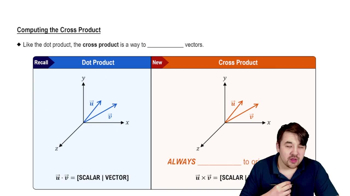
Computing the Cross Product
598
views
4
rank
Terms in this set (15)
Hide definitions
Cross Product
Operation yielding a vector perpendicular to two original vectors, calculated using a matrix and a specific pattern.
Dot Product
Operation combining two vectors to produce a scalar, contrasting with the vector result of another multiplication.
Vector
Mathematical object with magnitude and direction, often represented by components along axes.
Perpendicular Vector
Resultant vector from a specific operation, forming a right angle with the original vectors.
Matrix
Rectangular array used to organize unit vectors and components for systematic calculation.
Unit Vector
Standardized vector indicating direction along an axis, commonly labeled as i, j, or k.
Component Form
Representation of a vector using numerical values for each axis, such as (x, y, z).
i Component
Portion of a vector aligned with the x-axis, often used in calculations involving matrices.
j Component
Portion of a vector aligned with the y-axis, essential in matrix-based operations.
k Component
Portion of a vector aligned with the z-axis, included in three-dimensional calculations.
Cross Down and Up Strategy
Pattern-based approach for multiplying unlike components in a matrix to determine vector results.
Unlike Components
Elements from different axes multiplied together during a specific vector operation.
Pattern Recognition
Skill of identifying recurring structures in mathematical operations to simplify calculations.
Scalar
Single numerical value resulting from certain vector operations, distinct from vector outcomes.
Component Vector
Vector expressed as a tuple of values, each corresponding to an axis in space.
 BackBack
 05:21
05:21