Skip to main content
Trigonometry
My Course
Learn
Exam Prep
AI Tutor
Study Guides
Textbook Solutions
Flashcards
Explore
Try the app
My Course
Learn
Exam Prep
AI Tutor
Study Guides
Textbook Solutions
Flashcards
Explore
Try the app
Back
Reference Angles definitions
You can tap to flip the card.
Reference Angle
You can tap to flip the card.
👆
Reference Angle
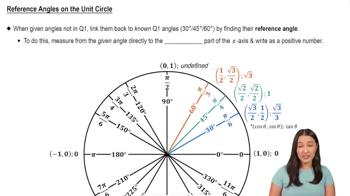
Always positive and measured to the nearest x-axis, matching a common angle in quadrant 1 for quick trig value calculation.
Track progress
Control buttons has been changed to "navigation" mode.
1/15
Related flashcards
Related practice
Recommended videos
Reference Angles quiz #1
Reference Angles
12 Terms
Reference Angles
3. Unit Circle
7 problems
Topic
Patrick
Reciprocal Trigonometric Functions on the Unit Circle
3. Unit Circle
3 problems
Topic
3. Unit Circle
5 topics
14 problems
Chapter
Patrick
Guided course
5:30
Trig Values in Quadrants II, III, & IV
1611
views
18
rank
1
comments
Guided course
5:31
Reference Angles on the Unit Circle
1973
views
19
rank
Guided course
3:47
Coterminal Angles on the Unit Circle
1412
views
10
rank
Terms in this set (15)
Hide definitions
Reference Angle
Always positive and measured to the nearest x-axis, matching a common angle in quadrant 1 for quick trig value calculation.
Quadrant
One of four regions on the unit circle, each affecting the sign of trigonometric values based on angle location.
Unit Circle
A circle with radius one, used to visualize angles and their corresponding trigonometric values.
Coterminal Angle
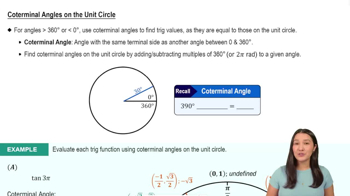
Shares the same terminal side as another angle, found by adding or subtracting full circle rotations.
Terminal Side
The ending position of an angle on the unit circle, used to determine coterminal angles.
Trigonometric Value
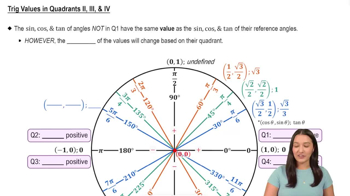
Numerical result for sine, cosine, or tangent, determined by the reference angle and quadrant sign.
Sine
Represents the y-coordinate on the unit circle, positive or negative depending on the quadrant.
Cosine
Represents the x-coordinate on the unit circle, sign changes with quadrant location.
Tangent
Ratio of y to x on the unit circle, sign determined by the quadrant and reference angle.
ASTC
Mnemonic for remembering which trigonometric function is positive in each quadrant: All, Sine, Tangent, Cosine.
Radian
Angle measure based on arc length, used alongside degrees for unit circle calculations.
Degree
Traditional angle measure, used to locate positions and reference angles on the unit circle.
X-Axis
Horizontal axis on the unit circle, used as a reference for measuring angles and finding reference angles.
Y-Axis
Vertical axis on the unit circle, helps determine the sign of trigonometric values.
Common Angle
Standard angles in quadrant 1, such as 30, 45, or 60 degrees, used as reference for other angles.
 BackBack
 5:30
5:30