If the measure of angle 6 is 32 degrees, what is the sum of the measures of angles 4 and 5 if they form a straight line?
The sum is 180 - 32 = 148 degrees.
What is the tangent ratio for an angle in a right triangle?
Tangent is the ratio of the length of the side opposite the angle to the length of the side adjacent to the angle.
How many sides does a regular polygon have if each interior angle measures 160 degrees?
n = 360 / (180 - 160) = 18 sides.
How many sides does a polygon have if the sum of the interior angles is 1080 degrees?
n = (1080/180) + 2 = 8 sides.
How many sides does a regular polygon have if each interior angle measures 144 degrees?
n = 360 / (180 - 144) = 10 sides.
If sin(θ) = x, what is the value of csc(θ)?
csc(θ) = 1 / sin(θ).
If three lines intersect to form a triangle, how do you find the value of an angle x?
Use the fact that the sum of the angles in a triangle is 180 degrees and solve for x.
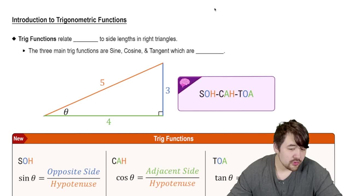
Which trigonometric ratio is calculated by dividing the length of the side opposite an angle by the length of the hypotenuse?
The sine ratio.
Given right triangle DEF, what is the value of sin(E)?
sin(E) = length of side opposite E / hypotenuse.
Given right triangle XYZ, what is the value of tan(60°)?
tan(60°) = √3.
What is the measure of each angle of a regular 22-gon? Round to the nearest tenth if necessary.
Each angle is [(22-2) × 180] ÷ 22 ≈ 163.6 degrees.
If a transversal cuts parallel lines and angle 4 = 55.1°, what are the measures of angles 5 and 7?
Angles 5 and 7 are also 55.1° (corresponding and alternate interior angles).
How do you find the measure of an arc in a circle given the central angle?
The measure of the arc in degrees is equal to the measure of the central angle.
How do you find the exact values of the six trigonometric ratios of an angle in a right triangle?
Use the side lengths: sin(θ) = opposite/hypotenuse, cos(θ) = adjacent/hypotenuse, tan(θ) = opposite/adjacent, csc(θ) = hypotenuse/opposite, sec(θ) = hypotenuse/adjacent, cot(θ) = adjacent/opposite.
Given that sin(j) = 20/29, cos(j) = 21/29, and tan(j) = 20/21, what do these ratios represent in terms of the sides of a right triangle?
These ratios represent the trigonometric functions for angle j in a right triangle: sin(j) = opposite/hypotenuse = 20/29, cos(j) = adjacent/hypotenuse = 21/29, and tan(j) = opposite/adjacent = 20/21.
In a right triangle, what is the general formula for sin(a) in terms of the sides of the triangle?
The sine of angle a, sin(a), is equal to the length of the side opposite angle a divided by the length of the hypotenuse: sin(a) = opposite/hypotenuse.
How do you write the trigonometric ratios for sin(a) and cos(a) in a right triangle?
In a right triangle, sin(a) = opposite/hypotenuse and cos(a) = adjacent/hypotenuse, where 'opposite' and 'adjacent' refer to the sides relative to angle a.
What is the trigonometric ratio for sin(c) in a right triangle?
The trigonometric ratio for sin(c) is the length of the side opposite angle c divided by the length of the hypotenuse: sin(c) = opposite/hypotenuse.
Which ratio defines the sine function in a right triangle?
The sine function is defined as the ratio of the length of the side opposite the angle to the length of the hypotenuse: sin(θ) = opposite/hypotenuse.
How do you find cos(b) in a right triangle?
To find cos(b), divide the length of the side adjacent to angle b by the length of the hypotenuse: cos(b) = adjacent/hypotenuse.