Skip to main content
Trigonometry
My Course
Learn
Exam Prep
AI Tutor
Study Guides
Textbook Solutions
Flashcards
Explore
Try the app
My Course
Learn
Exam Prep
AI Tutor
Study Guides
Textbook Solutions
Flashcards
Explore
Try the app
Back
Unit Vectors and i & j Notation definitions
You can tap to flip the card.
Vector
You can tap to flip the card.
👆
Vector
A mathematical quantity described by both magnitude and direction, often represented graphically as an arrow.
Track progress
Control buttons has been changed to "navigation" mode.
1/15
Related flashcards
Related practice
Recommended videos
Unit Vectors and i & j Notation quiz
Unit Vectors and i & j Notation
15 Terms
Unit Vectors and i & j Notation
8. Vectors
1 problem
Topic
Dot Product
8. Vectors
6 problems
Topic
Patrick
8. Vectors
5 topics
11 problems
Chapter
Patrick
Guided course
02:17
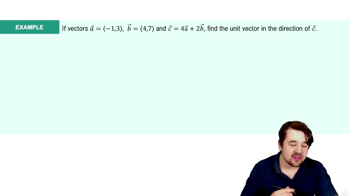
Unit Vector in the Direction of a Given Vector Example 1
707
views
3
rank
Guided course
06:01
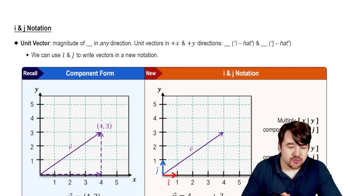
i & j Notation
976
views
4
rank
Guided course
05:21
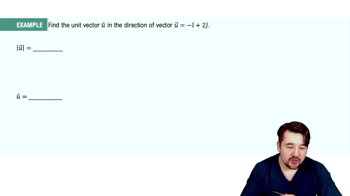
Unit Vector in the Direction of a Given Vector Example 2
631
views
1
rank
Terms in this set (15)
Hide definitions
Vector
A mathematical quantity described by both magnitude and direction, often represented graphically as an arrow.
Magnitude
The length or size of a vector, calculated using the square root of the sum of squared components.
Direction
The orientation in space that a vector points, indicated by its components or unit vector form.
Unit Vector
A vector with a magnitude of 1, used to indicate direction without affecting size.
Scalar
A quantity described only by magnitude, lacking any directional information.
Component Form
A representation of a vector using its x and y values, typically written as (x, y).
I Notation
A symbolic representation for the unit vector in the x direction, often written as I hat.
J Notation
A symbolic representation for the unit vector in the y direction, often written as J hat.
Vector Addition
A process of combining vectors by summing their corresponding components.
Vector Subtraction
A process of finding the difference between vectors by subtracting their corresponding components.
Resultant Vector
The outcome of adding or subtracting vectors, representing the combined effect.
Tip-to-Tail Method
A graphical technique for combining vectors by connecting the tail of one to the tip of another.
X Component
The horizontal value in a vector's component form, indicating movement along the x axis.
Y Component
The vertical value in a vector's component form, indicating movement along the y axis.
Normalization
The process of converting a vector to a unit vector by dividing each component by its magnitude.
 BackBack
 02:17
02:17