Skip to main content
Trigonometry
My Course
Learn
Exam Prep
AI Tutor
Study Guides
Textbook Solutions
Flashcards
Explore
Try the app
My Course
Learn
Exam Prep
AI Tutor
Study Guides
Textbook Solutions
Flashcards
Explore
Try the app
Back
Vectors in Component Form definitions
You can tap to flip the card.
Vector
You can tap to flip the card.
👆
Vector
Arrow-like quantity with direction and magnitude, often represented by numbers showing movement in space.
Track progress
Control buttons has been changed to "navigation" mode.
1/15
Related flashcards
Related practice
Recommended videos
Vectors in Component Form quiz
Vectors in Component Form
15 Terms
Vectors in Component Form
8. Vectors
3 problems
Topic
ErnestBlazevic
Direction of a Vector
8. Vectors
3 problems
Topic
ErnestBlazevic
8. Vectors
5 topics
11 problems
Chapter
Patrick
Guided course
02:26
Finding Magnitude of a Vector Example 2
652
views
5
rank
Guided course
03:55
Position Vectors & Component Form
878
views
4
rank
Guided course
03:11
Algebraic Operations on Vectors Example 3
660
views
7
rank
Terms in this set (15)
Hide definitions
Vector
Arrow-like quantity with direction and magnitude, often represented by numbers showing movement in space.
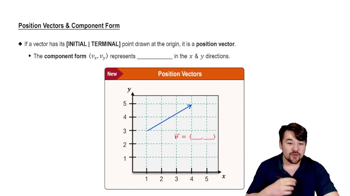
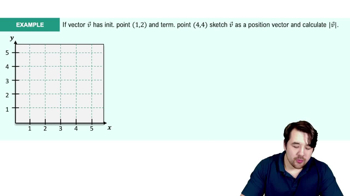
Position Vector
Representation with initial point at the origin, showing movement from (0,0) to a specific location.
Component Form
Ordered pair indicating movement in x and y directions, written as (x, y) for clarity and calculation.
Initial Point
Starting location of a vector, used to determine direction and calculate components.
Terminal Point
Ending location of a vector, essential for finding component values and direction.
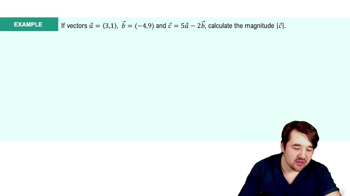
Magnitude
Numerical value representing the total length of a vector, calculated using its components.
Pythagorean Theorem
Formula relating the sides of a right triangle, used to compute vector length from components.
Resultant Vector
Outcome from combining two or more vectors, showing overall movement or effect.
Scalar
Single number used to scale a vector, affecting its length but not its direction.
Tip to Tail Method
Visual technique for combining vectors by connecting the end of one to the start of another.
x Component
Numerical value indicating movement along the horizontal axis in vector representation.
y Component
Numerical value indicating movement along the vertical axis in vector representation.
Vector Addition
Process of combining vectors by summing their corresponding components for a new vector.
Vector Subtraction
Process of finding the difference between vectors by subtracting their corresponding components.
Scalar Multiplication
Operation where each component of a vector is multiplied by a constant, changing its size.
 BackBack

 02:26
02:26