Pearson+ LogoPearson+ Logo
Ch. 5 - Trigonometric Identities
Lial - Trigonometry 12th Edition
Lial12th EditionTrigonometryISBN: 9780136552161Not the one you use?Change textbook
Chapter 6, Problem 5.8

Match each expression in Column I with its equivalent expression in Column II.
(tan (π/3) - tan (π/4))/(1 + tan (π/3) tan (π/4))

Verified step by step guidance
1
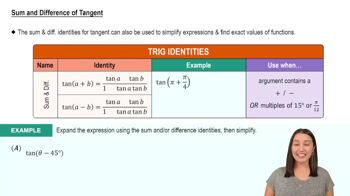
Identify the trigonometric identity for the difference of tangents: \( \frac{\tan A - \tan B}{1 + \tan A \tan B} = \tan(A - B) \).
Recognize that the given expression \( \frac{\tan(\pi/3) - \tan(\pi/4)}{1 + \tan(\pi/3) \tan(\pi/4)} \) matches the form of the tangent difference identity.
Substitute \( A = \pi/3 \) and \( B = \pi/4 \) into the identity, so the expression becomes \( \tan((\pi/3) - (\pi/4)) \).
Calculate the angle difference: \( (\pi/3) - (\pi/4) = \pi/12 \).
Conclude that the expression simplifies to \( \tan(\pi/12) \).

Verified video answer for a similar problem:

This video solution was recommended by our tutors as helpful for the problem above.
Was this helpful?

Key Concepts

Here are the essential concepts you must grasp in order to answer the question correctly.

Tangent Function

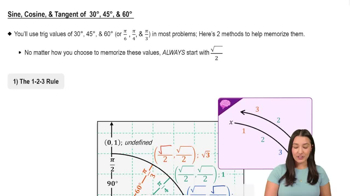
The tangent function, denoted as tan(θ), is a fundamental trigonometric function defined as the ratio of the opposite side to the adjacent side in a right triangle. It can also be expressed in terms of sine and cosine as tan(θ) = sin(θ)/cos(θ). Understanding the values of tan at specific angles, such as π/3 and π/4, is crucial for evaluating expressions involving these angles.
Recommended video:
5:43
Introduction to Tangent Graph

Trigonometric Identities

Trigonometric identities are equations that involve trigonometric functions and are true for all values of the variables involved. One important identity is the tangent subtraction formula: tan(A - B) = (tan A - tan B) / (1 + tan A tan B). This identity is essential for simplifying expressions that involve the tangent of angles, such as the one presented in the question.
Recommended video:
5:32
Fundamental Trigonometric Identities

Angle Measurement in Radians

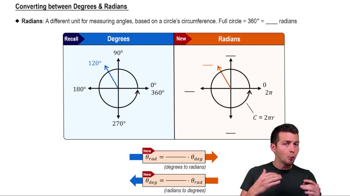
In trigonometry, angles can be measured in degrees or radians, with radians being the standard unit in mathematical contexts. The angles π/3 and π/4 correspond to 60 degrees and 45 degrees, respectively. Understanding how to convert between these two units and the significance of these specific radian measures is important for accurately evaluating trigonometric expressions.
Recommended video:
5:04
Converting between Degrees & Radians