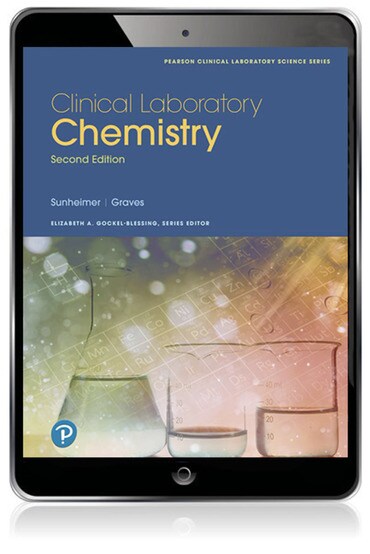
Clinical Laboratory Chemistry, 2nd edition

Published by Pearson (July 29, 2020) © 2021

  • Robert Sunheimer MSMT(ASCP)SC,SLS,Professor Emeritus SUNY Upstate Medical University of Syracuse
  • Linda Graves

In this eTextbook — More ways to learn

  • More flexible. Start learning right away, on any device.
  • More supportive. Get AI explanations and practice questions (select titles).
  • More interactive. Bring learning to life with audio, videos, and diagrams.
  • More memorable. Make concepts stick with highlights, search, notes, and flashcards.
  • More understandable. Translate text into 100+ languages with one tap.

In this eTextbook — More ways to learn

  • More flexible. Start learning right away, on any device.
  • More supportive. Get AI explanations and practice questions (select titles).
  • More interactive. Bring learning to life with audio, videos, and diagrams.
  • More memorable. Make concepts stick with highlights, search, notes, and flashcards.
  • More understandable. Translate text into 100+ languages with one tap.

In this eTextbook — More ways to learn

  • More flexible. Start learning right away, on any device.
  • More supportive. Get AI explanations and practice questions (select titles).
  • More interactive. Bring learning to life with audio, videos, and diagrams.
  • More memorable. Make concepts stick with highlights, search, notes, and flashcards.
  • More understandable. Translate text into 100+ languages with one tap.

Title overview

Clinical Laboratory Chemistry is a highly readable introduction to essential analytes, for CLT/MLT and CLS/MT students. It's part of Pearson's clinical laboratory science series, which offers a balanced, engaging presentation of theory and application. The text focuses on clinically significant analyses you're likely to encounter in the lab.

The 2nd Edition expands upon detailed technical information. Its real case studies help you synthesize and analyze information, while building an appreciation for the significant role that laboratory chemists play in patient care. New mini cases clarify the principles and add to the book's real-life focus. New figures and photographs add to the book's aesthetic appeal and visually oriented learning approach.

Table of contents

1. Laboratory Basics
2. Safety in the Clinical Chemistry Laboratory
3. Laboratory Statistics, Method Development, and Quality Control
4. Instrumentation, Laboratory Automation, and Informatics
5. Immunoassays
6. Molecular Diagnostics
7. Carbohydrates
8. Lipids and Lipoproteins
9. Amino Acids and Proteins
10. Enzymes
11. Nonprotein Nitrogen and Renal Function
12. Body Water and Electrolyte Homeostasis
13. Blood Gases, pH, and Acid¿Base Balance
14. Mineral and Bone Metabolism
15. The Endocrine System
16. Gastrointestinal Function
17. Pancreas
18. Cardiac Function
19. Liver Function
20. Iron, Porphyrins, and Hemoglobin
21. Therapeutic Drug Monitoring
22. Toxic Substances
23. Nutrition and Vitamins
24. Tumor Markers
25. Geriatric Clinical Chemistry
26. Pediatrics

Appendices
U.S. Customary System of Measurement of Length, Area, Liquid, and Mass
Conversions From U.S. Customary Metric Units
Metric Prefixes for the Basic Units of Measurement
Conversion Among Different Measurements Within the Metric System
Base Units of Le Système Internationale D'unités
Derived Units of Le Système Internationale D'unités
Common Acids and Bases Used in Laboratories
Ph Values and their Corresponding Hydrogen and Hydroxyl Molar Concentrations
Nomogram for the Determination of Body Surface Area of Children and Adults
Body Mass Index (BMI) Table
Reference Intervals for Selected Analytes
Periodic Table of Elements

Author bios

This publication contains markup to enable structural navigation and compatibility with assistive technologies. Images in the publication are fully described. The publication supports text reflow, is screen-reader friendly, and contains no content hazards known to cause adverse physical reactions.

Need help?Get in touch