Back

Dipole Moment quiz

Control buttons has been changed to "navigation" mode.
1/15
  • What is electronegativity and how does it trend on the periodic table?

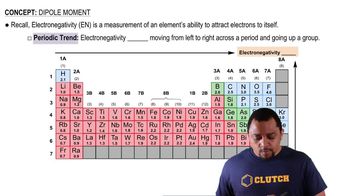
    Electronegativity is an atom's ability to attract electrons to itself, and it increases from left to right across a period and up a group.
  • Which element is the most electronegative and why are noble gases usually excluded from electronegativity discussions?

    Fluorine is the most electronegative element, and noble gases are usually excluded because they have full valence shells and rarely form bonds.
  • What is a dipole moment in a chemical bond?

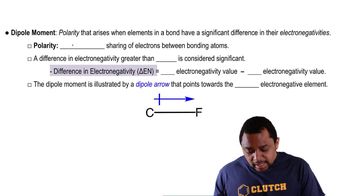
    A dipole moment is the polarity that arises when atoms in a bond have a significant difference in electronegativity, leading to unequal electron sharing.
  • At what difference in electronegativity does a bond become polar and show a dipole moment?

    A bond becomes polar and shows a dipole moment when the difference in electronegativity is greater than 0.4.
  • How is the direction of a dipole arrow determined in a polar bond?

    The dipole arrow points toward the more electronegative atom, indicating the direction of greater electron density.
  • What do the symbols δ- and δ+ represent in a dipole moment?

    δ- represents a partial negative charge on the more electronegative atom, and δ+ represents a partial positive charge on the less electronegative atom.
  • How do you calculate the difference in electronegativity between two atoms?

    Subtract the lower electronegativity value from the higher one to find the difference.
  • What type of bond exists when the electronegativity difference is 0?

    A pure covalent (nonpolar) bond exists when the electronegativity difference is 0.
  • What is the range of electronegativity difference for a nonpolar covalent bond?

    A nonpolar covalent bond has an electronegativity difference between 0.1 and 0.4.
  • What is the range of electronegativity difference for a polar covalent bond?

    A polar covalent bond has an electronegativity difference between 0.5 and 1.7.
  • What type of bond forms when the electronegativity difference is greater than 1.7?

    An ionic bond forms when the electronegativity difference is greater than 1.7.
  • How do electron sharing and charge differ between polar covalent and ionic bonds?

    Polar covalent bonds have unequal sharing and partial charges, while ionic bonds involve electron transfer and full charges.
  • What happens to the electron cloud in a nonpolar covalent bond?

    In a nonpolar covalent bond, the electron cloud is shared equally between the atoms.
  • How does the size of the dipole arrow relate to bond polarity?

    A larger dipole arrow indicates greater bond polarity due to a larger difference in electronegativity.
  • Why does the dipole arrow have a positive sign at one end?

    The positive sign at the tail of the dipole arrow represents the partially positive atom in the bond.