Which of the following incorrectly assigns a dipole moment to a bond?
A bond between two atoms with the same electronegativity (e.g., Cl-Cl) is incorrectly assigned a dipole moment, as there is no difference in electronegativity and thus no dipole.
Which atom in the Br-F molecule has a partial positive charge (δ+)?
In Br-F, bromine (Br) has the partial positive charge (δ+) because fluorine is more electronegative and attracts electrons more strongly.
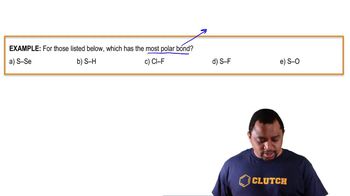
Which bond is the most polar?
The bond with the greatest difference in electronegativity between the two atoms is the most polar, such as H-F.
Which molecule in each pair has the greater dipole moment? (a) O3 or SO2 (b) HBr or HCl
(a) SO2 has a greater dipole moment than O3; (b) HCl has a greater dipole moment than HBr.
Which diatomic molecule has the largest dipole moment?
HF (hydrogen fluoride) has the largest dipole moment among common diatomic molecules due to the large electronegativity difference between H and F.
Why does oxygen have the partial negative and hydrogen have the partial positive in a water molecule?
Oxygen is more electronegative than hydrogen, so it attracts the shared electrons more strongly, making it partially negative (δ-) and hydrogen partially positive (δ+).
Which of the following diagrams best represents the net-dipole moment of the molecule?
The correct diagram shows a dipole arrow pointing from the partially positive end (less electronegative atom) to the partially negative end (more electronegative atom), indicating the direction of the net dipole.
Which of the following forms the most polar bond?
The pair of atoms with the largest difference in electronegativity forms the most polar bond, such as H-F.
If two atoms bonded together have an electronegativity difference of 1.9, what type of bond is formed?
A difference of 1.9 indicates an ionic bond, where electrons are transferred and full charges develop.
Which of the following molecules has a dipole moment?
A molecule with polar bonds arranged asymmetrically, such as H2O, has a dipole moment.
Which bond would have the largest dipole moment?
The bond between atoms with the greatest electronegativity difference, such as H-F, would have the largest dipole moment.
Which of the following can be best explained by temporary dipole moments?
London dispersion forces (induced dipole-induced dipole interactions) are best explained by temporary dipole moments.
Which of the following has the largest dipole moment?
The molecule with the most polar bonds arranged asymmetrically, such as H2O, has the largest dipole moment.
Which bond term describes a covalent bond in which electrons are shared unequally?
A polar covalent bond describes a covalent bond in which electrons are shared unequally.
Which atom in the C-Br bond has a partial negative charge (δ-)?
In a C-Br bond, bromine (Br) is more electronegative and has the partial negative charge (δ-).
Which pair of atoms forms the most polar bond?
The pair with the largest difference in electronegativity, such as H and F, forms the most polar bond.
Which of the following bonds would be the most polar without being considered ionic?
A bond with an electronegativity difference between 0.5 and 1.7, such as H-Cl, is the most polar without being ionic.
Which part of the molecule has a partial positive charge?
The atom with the lower electronegativity in a polar bond has the partial positive charge (δ+).
When is a covalent bond described as polar?
A covalent bond is described as polar when the difference in electronegativity between the two atoms is greater than 0.4.
Which bond in the methyl amine molecule is the most polar?
The N-H bond in methyl amine is the most polar because nitrogen is much more electronegative than hydrogen.
Which pair of molecules has the strongest dipole-dipole interactions?
The pair of molecules with the largest dipole moments, such as H2O and HCl, have the strongest dipole-dipole interactions.
Does the AlCl3 molecule have a dipole moment?
No, AlCl3 is a symmetrical molecule, so its bond dipoles cancel and it does not have a net dipole moment.
Which one of the following molecules does not have a dipole moment?
A molecule with symmetrical geometry and identical surrounding atoms, such as CO2, does not have a dipole moment.
Why is water called a polar molecule?
Water is called a polar molecule because it has polar O-H bonds and a bent shape, resulting in a net dipole moment.
Explain why water is a polar molecule.
Water is polar because oxygen is more electronegative than hydrogen, and the molecule's bent shape causes the dipoles to add up to a net dipole moment.
Where is the majority of negative charge on the water molecule?
The majority of negative charge is located on the oxygen atom in the water molecule.
Which diatomic molecule has the smallest (lowest) dipole moment?
A diatomic molecule with identical atoms, such as N2 or O2, has the smallest (zero) dipole moment.
Which best describes how charges are distributed on a water molecule?
The oxygen atom has a partial negative charge (δ-), and the hydrogen atoms have partial positive charges (δ+).
Do the molecules below have a permanent electric dipole moment?
Molecules with polar bonds arranged asymmetrically have a permanent electric dipole moment; symmetrical molecules do not.
Which of these AF3 molecules will have a nonzero dipole moment?
An AF3 molecule with an asymmetrical geometry (such as a trigonal pyramidal shape) will have a nonzero dipole moment.
What is the location of the negative pole in CH3Cl?
The negative pole (δ-) in CH3Cl is located on the chlorine atom.
Which of these statements about a dipole are correct? Select all that are true.
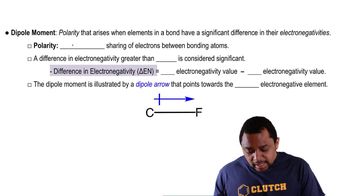
A dipole occurs when electrons are shared unequally; the dipole arrow points toward the more electronegative atom; the more electronegative atom has a partial negative charge.
Which H2S molecule's dipole moment is correctly labeled?
The correct H2S dipole moment is shown with the dipole arrow pointing from the hydrogen atoms toward the sulfur atom, which is more electronegative.
Which part of the molecule has a partial negative charge?
The atom with the highest electronegativity in a polar bond has the partial negative charge (δ-).
Draw a dipole-dipole diagram for a polar molecule.
A dipole-dipole diagram shows molecules with arrows pointing from the partially positive end (δ+) to the partially negative end (δ-), aligning so that opposite charges attract.
What does it mean for a molecule to have a slight positive charge at one end and a slight negative charge on the other?
It means the molecule is polar, with a dipole moment due to unequal sharing of electrons.
A water molecule has a positive end and a negative end. This makes it a _______.
This makes it a polar molecule.
A covalent bond is likely to be polar when ________.
A covalent bond is likely to be polar when the two atoms have a significant difference in electronegativity (greater than 0.4).
Does HCN have dipole-dipole forces?
Yes, HCN is a polar molecule and exhibits dipole-dipole forces.
For each bond, select the arrow that indicates the direction of bond polarity.
The arrow should point from the less electronegative atom to the more electronegative atom, indicating the direction of electron density.