Ch. 2 - Exploring Data with Tables and Graphs
Triola - Elementary Statistics 14th Edition
Triola14th EditionElementary StatisticsISBN: 9780137366446Not the one you use?Change textbook
Chapter 2, Problem 2.3.6

In Exercises 5 and 6, construct the dotplot.


Diastolic Blood Pressure Listed below are diastolic blood pressure measurements (mm Hg) of females selected from Data Set 1 “Body Data” in Appendix B. All of the values are even numbers. Are there any outliers? If so, identify their values.
Diastolic blood pressure measurements in mm Hg, all even numbers, displayed in a horizontal list format.

Verified step by step guidance
1
Step 1: Organize the data in ascending order. This will make it easier to construct the dotplot and identify any potential outliers. The data is: 60, 60, 62, 62, 64, 66, 68, 70, 70, 70, 70, 72, 74, 76, 76, 78, 78, 82, 82, 84, 86, 88, 90, 90.
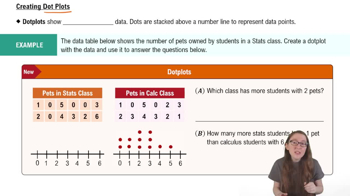
Step 2: Construct a dotplot. For each unique value in the data set, place a dot above the corresponding value on a number line. If a value appears multiple times, stack the dots vertically.
Step 3: Calculate the interquartile range (IQR) to identify potential outliers. First, find the first quartile (Q1) and third quartile (Q3). Q1 is the median of the lower half of the data, and Q3 is the median of the upper half. Then, compute the IQR as IQR = Q3 - Q1.
Step 4: Determine the outlier boundaries. Use the formula: Lower boundary = Q1 - 1.5 * IQR and Upper boundary = Q3 + 1.5 * IQR. Any data points outside these boundaries are considered outliers.
Step 5: Compare the data points to the outlier boundaries. Identify any values that fall below the lower boundary or above the upper boundary. These values are the outliers, if any exist.

Verified video answer for a similar problem:

This video solution was recommended by our tutors as helpful for the problem above.
Video duration:
5m
Was this helpful?

Key Concepts

Here are the essential concepts you must grasp in order to answer the question correctly.

Dotplot

A dotplot is a simple graphical display used to represent the distribution of a dataset. Each data point is represented by a dot above its corresponding value on a number line. This visualization helps in identifying patterns, clusters, and potential outliers in the data, making it easier to analyze the overall distribution.
Recommended video:
04:01
Creating Dotplots

Outliers

Outliers are data points that significantly differ from the other observations in a dataset. They can be unusually high or low values that may indicate variability in the measurement or errors in data collection. Identifying outliers is crucial as they can skew statistical analyses and affect the interpretation of results.
Recommended video:
Guided course
04:48
Comparing Mean vs. Median

Diastolic Blood Pressure

Diastolic blood pressure is the pressure in the arteries when the heart rests between beats. It is one of the two measurements used to assess blood pressure, the other being systolic blood pressure. Understanding diastolic blood pressure is important in evaluating cardiovascular health and identifying potential health risks.
Recommended video:
Guided course
07:23
Matched Pairs: Hypothesis Tests
Related Practice
Textbook Question

IQ Scores IQ scores of adults are normally distributed. If a large sample of adults is randomly selected and the IQ scores are illustrated in a histogram, what is the shape of that histogram?

251
views
Textbook Question

In Exercises 9 and 10, construct the time-series graph.


Home Runs Listed below are the numbers of home runs in Major League Baseball for each year beginning with 1993 (listed in order by row). Is there a trend?

117
views
Textbook Question

In Exercises 15 and 16, construct the frequency polygons.

Presidents Use the frequency distribution from Exercise 14 in Section 2-1 to construct a frequency polygon. Does the graph suggest that the distribution is skewed? If so, how?

151
views
Textbook Question

In Exercises 5–8, identify the class width, class midpoints, and class boundaries for the given frequency distribution. Also identify the number of individuals included in the summary. The frequency distributions are based on real data from Appendix B.

477
views
Textbook Question

In Exercises 9–12, using a loose interpretation of the criteria for determining whether a frequency distribution is approximately a normal distribution, determine whether the given frequency distribution is approximately a normal distribution. Give a brief explanation.

Blood Platelet Counts of Females Refer to the frequency distribution from Exercise 8

125
views
Textbook Question

Use Table 2-11 to find the critical values of r. Based on a comparison of the linear correlation coefficient r and the critical values, what do you conclude about a linear correlation?

Using the data from Exercise 6 “Airport Data Speeds,” the linear correlation coefficient is r = 0.866

255
views