
Ch. 11 - Goodness-of-Fit and Contingency Tables
Triola - Elementary Statistics 14th Edition
Triola14th EditionElementary StatisticsISBN: 9780137366446Not the one you use?Change textbook
Chapter 11, Problem 11.1.25c

Testing Goodness-of-Fit with a Normal Distribution Refer to Data Set 1 “Body Data” in Appendix B for the heights of females.


<IMAGE>


c. Using the probabilities found in part (b), find the expected frequency for each category.

Verified step by step guidance
1
Step 1: Identify the total number of observations in the dataset. This is necessary to calculate the expected frequency for each category.
Step 2: Use the probabilities found in part (b) for each height category. These probabilities represent the proportion of the population expected to fall into each category under the assumption of a normal distribution.
Step 3: Multiply the total number of observations by the probability for each category to calculate the expected frequency for that category. The formula is: Expected Frequency = Total Observations × Probability.
Step 4: Repeat the calculation for each height category (e.g., 'Less than 155.45', '155.45 – 162.05', '162.05 – 168.65', 'Greater than 168.65').
Step 5: Verify that the sum of the expected frequencies across all categories equals the total number of observations. This ensures consistency in the calculations.

Verified video answer for a similar problem:

This video solution was recommended by our tutors as helpful for the problem above.
Video duration:
1m
Was this helpful?

Key Concepts

Here are the essential concepts you must grasp in order to answer the question correctly.

Goodness-of-Fit Test

A goodness-of-fit test is a statistical hypothesis test used to determine how well a sample distribution fits a theoretical distribution, such as the normal distribution. It compares the observed frequencies of data in different categories to the expected frequencies derived from the theoretical model. This test helps assess whether the data follows a specific distribution, which is crucial for validating assumptions in statistical analyses.
Recommended video:
Guided course
06:34
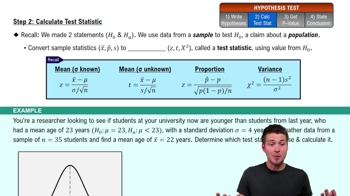
Step 2: Calculate Test Statistic

Expected Frequency

Expected frequency refers to the number of occurrences that would be expected in each category of a distribution if the null hypothesis is true. It is calculated by multiplying the total number of observations by the probability of each category. In the context of a goodness-of-fit test, expected frequencies are compared to observed frequencies to evaluate how well the data aligns with the expected distribution.
Recommended video:
04:41
Creating Frequency Polygons

Normal Distribution

The normal distribution is a continuous probability distribution characterized by its bell-shaped curve, defined by its mean and standard deviation. It is symmetric around the mean, with most observations clustering around the central peak and probabilities tapering off equally in both directions. Many statistical methods assume normality, making it essential to test whether a dataset follows this distribution, especially in fields like psychology, biology, and social sciences.
Recommended video:
Guided course
09:47
Finding Standard Normal Probabilities using z-Table
Related Practice
Textbook Question

Cybersecurity The table below lists the frequency of leading digits of Internet traffic interarrival times for a computer, along with the percentages of each leading digit expected with Benford’s law.


b. Identify the observed and expected values for the leading digit of 2.


" style="max-width: 100%; white-space-collapse: preserve;" width="650">

107
views
Textbook Question

Testing Goodness-of-Fit with a Normal Distribution Refer to Data Set 1 “Body Data” in Appendix B for the heights of females.


" style="max-width: 100%; white-space-collapse: preserve;" width="600">


b. Assuming a normal distribution with mean and standard deviation given by the sample mean and standard deviation, use the methods of Chapter 6 to find the probability of a randomly selected height belonging to each class.

160
views
Textbook Question

Questions 6–10 refer to the sample data in the following table, which describes the fate of the passengers and crew aboard the Titanic when it sank on April 15, 1912. Assume that the data are a sample from a large population and we want to use a 0.05 significance level to test the claim that surviving is independent of whether the person is a man, woman, boy, or girl.


What distribution is used to test the stated claim (normal, t, F, chi-square, uniform)?

126
views
Textbook Question

Questions 6–10 refer to the sample data in the following table, which describes the fate of the passengers and crew aboard the Titanic when it sank on April 15, 1912. Assume that the data are a sample from a large population and we want to use a 0.05 significance level to test the claim that surviving is independent of whether the person is a man, woman, boy, or girl.


Is the hypothesis test left-tailed, right-tailed, or two-tailed?

94
views
Textbook Question

Exercises 1–5 refer to the sample data in the following table, which summarizes the frequencies of 500 digits randomly generated by Statdisk. Assume that we want to use a 0.05 significance level to test the claim that Statdisk generates the digits in a way that they are equally likely.


What are the null and alternative hypotheses corresponding to the stated claim?

113
views
Textbook Question

Cybersecurity The table below lists the frequency of leading digits of Internet traffic interarrival times for a computer, along with the percentages of each leading digit expected with Benford’s law.


c. Use the results from part (b) to find the contribution to the x2 test statistic from the category representing the leading digit of 2.


" style="max-width: 100%; white-space-collapse: preserve;" width="650">

116
views