Back

Le Chatelier's Principle quiz

Control buttons has been changed to "navigation" mode.
1/15
  • What does Le Chatelier's principle state about a chemical reaction at equilibrium when disturbed?

    It states that the reaction will shift in a direction to minimize the disturbance and restore equilibrium.
  • What happens to the equilibrium when reactants are added or products are removed?

    The reaction shifts to the right (forward direction), increasing product concentration and decreasing reactant concentration.
  • How does the equilibrium shift when reactants are removed or products are added?

    The reaction shifts to the left (reverse direction), increasing reactant concentration and decreasing product concentration.
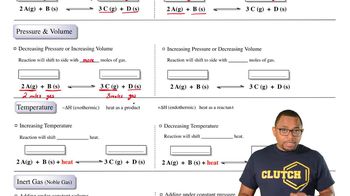
  • What effect does decreasing pressure or increasing volume have on a reaction at equilibrium?

    The reaction shifts toward the side with more moles of gas.
  • How does increasing pressure or decreasing volume affect the equilibrium position?

    The reaction shifts toward the side with fewer moles of gas.
  • If both sides of a reaction have equal numbers of gas molecules, what happens when pressure or volume is changed?

    No shift occurs in the equilibrium position.
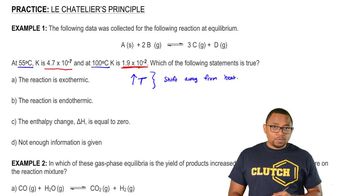
  • How do you determine the effect of temperature changes on equilibrium?

    First, identify if the reaction is exothermic (heat as product) or endothermic (heat as reactant), then apply the temperature change accordingly.
  • What happens to an exothermic reaction at equilibrium when temperature is increased?

    The reaction shifts away from heat, which is the product side, so it shifts to the left (reverse direction).
  • How does an endothermic reaction respond to an increase in temperature?

    The reaction shifts away from heat, which is the reactant side, so it shifts to the right (forward direction).
  • What is the effect of decreasing temperature on an exothermic reaction?

    The reaction shifts toward heat, which is the product side, so it shifts to the right (forward direction).
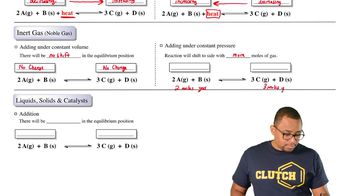
  • What happens when an inert gas is added under constant volume?

    There is no shift in the equilibrium position; the reaction does not move in either direction.
  • How does adding an inert gas under constant pressure affect equilibrium?

    The reaction shifts toward the side with more moles of gas.
  • What is the effect of adding or removing liquids or solids on the equilibrium position?

    There is no change in the equilibrium position because liquids and solids are not included in equilibrium expressions.
  • How does the addition of a catalyst affect the equilibrium position?

    A catalyst does not affect the equilibrium position; it only increases the rate at which equilibrium is reached.
  • Why are solids and liquids ignored in equilibrium calculations?

    They do not influence equilibrium amounts and are not included in equilibrium expressions.