Ch. 2 Chemistry Comes Alive
Marieb - Human Anatomy & Physiology 11th Edition
Marieb, Hoehn11th EditionHuman Anatomy & PhysiologyISBN: 9780136874034Not the one you use?Change textbook
Chapter 2, Problem 16

A chemist, during the course of an analysis, runs across a chemical composed of carbon, hydrogen, and oxygen in the proportion 1:2:1 and having a six-sided molecular shape. It is probably:
a. A pentose
b. An amino acid
c. A fatty acid
d. A monosaccharide
e. A nucleic acid

Verified step by step guidance
1
Step 1: Identify the elemental ratio given in the problem: carbon, hydrogen, and oxygen in the proportion 1:2:1. This ratio is a key clue to the type of molecule.
Step 2: Recall that carbohydrates typically have the general formula \(C_nH_{2n}O_n\), which matches the 1:2:1 ratio of carbon to hydrogen to oxygen atoms.
Step 3: Consider the molecular shape described as six-sided. This suggests a ring structure with six atoms, which is common in monosaccharides like glucose that form six-membered rings (hexoses).
Step 4: Evaluate the options: a pentose is a five-carbon sugar, an amino acid contains nitrogen and does not follow the 1:2:1 ratio, a fatty acid has a different elemental composition, and nucleic acids are polymers containing nitrogenous bases and phosphate groups.
Step 5: Conclude that the molecule is most likely a monosaccharide, as it fits both the elemental ratio and the six-sided ring structure.

Verified video answer for a similar problem:

This video solution was recommended by our tutors as helpful for the problem above.
Video duration:
2m

Key Concepts

Here are the essential concepts you must grasp in order to answer the question correctly.

Empirical Formula and Molecular Composition

The empirical formula represents the simplest whole-number ratio of elements in a compound. A ratio of carbon, hydrogen, and oxygen as 1:2:1 is characteristic of carbohydrates, especially monosaccharides, which often follow the general formula Cn(H2O)n.
Recommended video:
Guided course
7:49
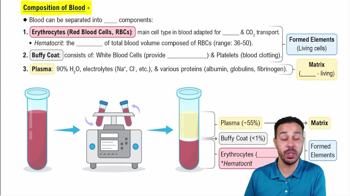
Composition of Blood

Monosaccharide Structure and Characteristics

Monosaccharides are simple sugars with a basic formula of (CH2O)n, commonly forming ring structures with six atoms (five carbons and one oxygen). Their six-membered ring shape (pyranose form) is typical for glucose and related sugars.
Recommended video:
04:15
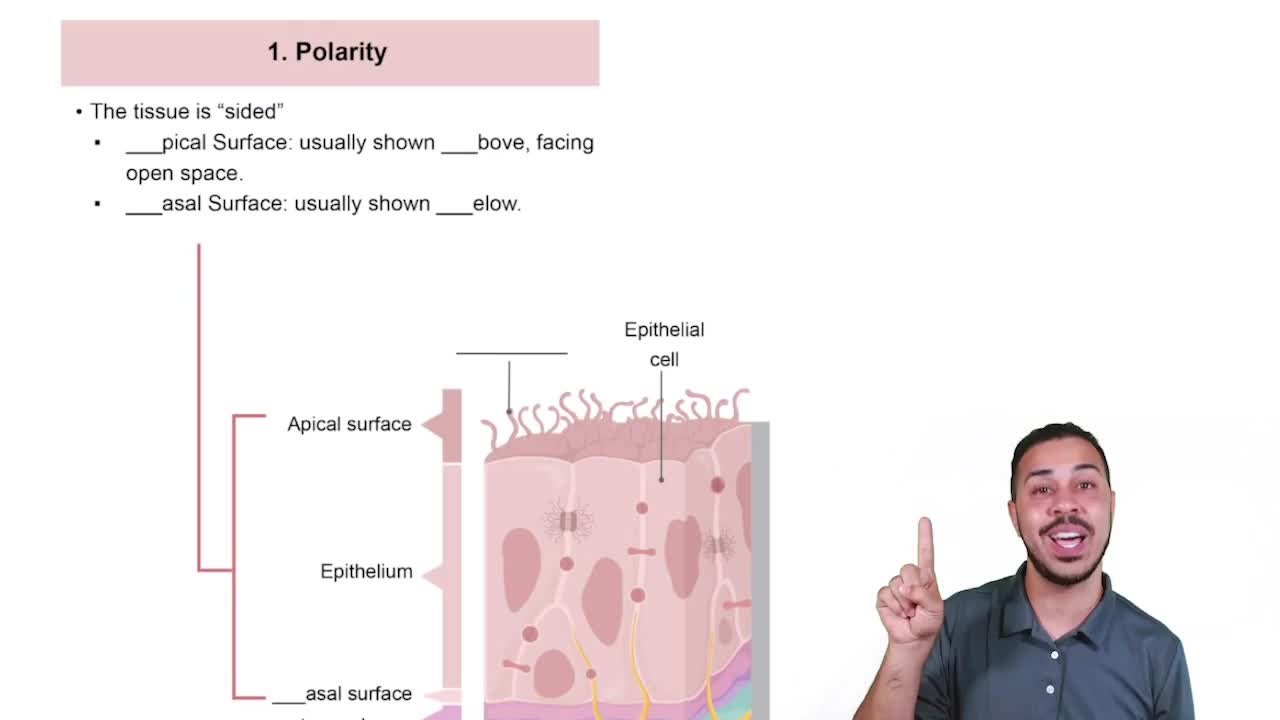
Characteristic 1: Polarity

Distinguishing Biomolecules by Composition and Structure

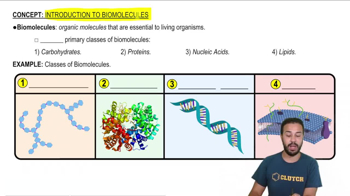
Different biomolecules have distinct elemental ratios and structures: amino acids contain nitrogen, fatty acids have long hydrocarbon chains with few oxygens, nucleic acids contain nitrogen and phosphorus, while pentoses are five-carbon sugars. Recognizing these differences helps identify the compound.
Recommended video:
Guided course
01:22
Introduction to Biomolecules