Pearson+ LogoPearson+ Logo
Ch. 10 Molecular Biology of the Gene
Taylor - Campbell Biology: Concepts & Connections 10th Edition
Taylor, Simon, Dickey, Hogan10th EditionCampbell Biology: Concepts & ConnectionsISBN: 9780136538783Not the one you use?Change textbook
Chapter 10, Problem 2

Which of the following correctly ranks the structures in order of size, from largest to smallest?
a. Gene–Chromosome–Nucleotide–Codon
b. Chromosome–Gene–Codon–Nucleotide
c. Nucleotide–Chromosome–Gene–Codon
d. Chromosome–Nucleotide–Gene–Codon

Verified step by step guidance
1
Understand the hierarchy of genetic structures: A chromosome is the largest structure, containing many genes. Genes are segments of DNA that code for proteins, and they are composed of sequences of nucleotides. Codons are specific sequences of three nucleotides that correspond to amino acids or stop signals during protein synthesis.
Analyze the options provided. Each option lists the structures in a specific order. To determine the correct ranking, compare the relative sizes of the structures based on the hierarchy described in the first step.
Start with the largest structure, which is the chromosome. Eliminate any options that do not list the chromosome as the largest structure.
Next, identify the second largest structure, which is the gene. Eliminate any options that do not list the gene immediately after the chromosome.
Finally, confirm the order of the smaller structures: codons (three-nucleotide sequences) are larger than individual nucleotides. Use this information to identify the correct ranking from the options provided.

Verified video answer for a similar problem:

This video solution was recommended by our tutors as helpful for the problem above.
Video duration:
1m
Was this helpful?

Key Concepts

Here are the essential concepts you must grasp in order to answer the question correctly.

Chromosomes

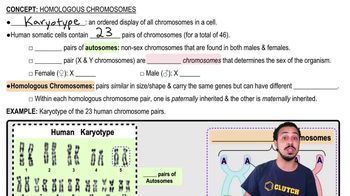
Chromosomes are long, thread-like structures made of DNA and proteins that contain genetic information. In humans, each cell typically contains 23 pairs of chromosomes, which house many genes. They are the largest structures in the hierarchy of genetic material, serving as the organizational units for DNA.
Recommended video:
Guided course
08:09
Homologous Chromosomes

Genes

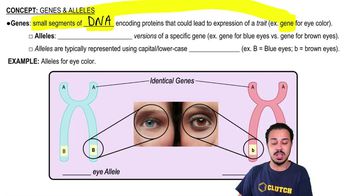
Genes are segments of DNA located on chromosomes that encode instructions for building proteins. Each gene can vary in size and is responsible for specific traits or functions in an organism. They are smaller than chromosomes but larger than codons and nucleotides.
Recommended video:
Guided course
05:02
Genes & Alleles

Nucleotides and Codons

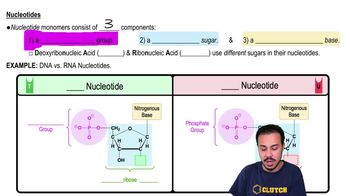
Nucleotides are the basic building blocks of DNA and RNA, consisting of a sugar, a phosphate group, and a nitrogenous base. Codons are sequences of three nucleotides that correspond to specific amino acids during protein synthesis. Codons are smaller than nucleotides, as they are formed by combinations of three nucleotides.
Recommended video: