Pearson+ LogoPearson+ Logo
Ch. 10 Molecular Biology of the Gene
Taylor - Campbell Biology: Concepts & Connections 10th Edition
Taylor, Simon, Dickey, Hogan10th EditionCampbell Biology: Concepts & ConnectionsISBN: 9780136538783Not the one you use?Change textbook
Chapter 10, Problem 4

What is the name of the process that produces RNA from a DNA template?
What is the name of the process that produces a polypeptide from an RNA template?

Verified step by step guidance
1
Step 1: Understand the first part of the question, which asks for the name of the process that produces RNA from a DNA template. This process is a fundamental step in gene expression and involves the synthesis of RNA using DNA as a template.
Step 2: Recall that the enzyme responsible for this process is RNA polymerase, which binds to the DNA at a specific region called the promoter and facilitates the synthesis of RNA.
Step 3: Learn that this process is called 'transcription,' where the DNA sequence is transcribed into a complementary RNA sequence.
Step 4: For the second part of the question, understand that it asks for the name of the process that produces a polypeptide (protein) from an RNA template. This process involves decoding the RNA sequence into a chain of amino acids.
Step 5: Recall that this process is called 'translation,' where the ribosome reads the mRNA sequence and tRNA molecules bring the corresponding amino acids to form a polypeptide chain.

Verified video answer for a similar problem:

This video solution was recommended by our tutors as helpful for the problem above.
Video duration:
1m
Was this helpful?

Key Concepts

Here are the essential concepts you must grasp in order to answer the question correctly.

Transcription

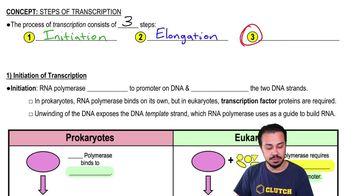
Transcription is the process by which RNA is synthesized from a DNA template. During this process, the enzyme RNA polymerase binds to a specific region of the DNA and unwinds the double helix. It then synthesizes a single strand of RNA by adding complementary RNA nucleotides to the growing chain, effectively copying the genetic information encoded in the DNA.
Recommended video:
Guided course
04:16
1) Initiation of Transcription

Translation

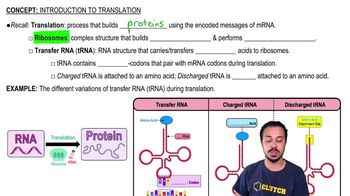
Translation is the process through which a polypeptide chain is synthesized from an RNA template, specifically messenger RNA (mRNA). This occurs in the ribosome, where the mRNA sequence is read in sets of three nucleotides, called codons. Each codon corresponds to a specific amino acid, and transfer RNA (tRNA) molecules bring the appropriate amino acids to the ribosome, facilitating the assembly of the polypeptide.
Recommended video:
Guided course
06:12
Introduction to Translation

Central Dogma of Molecular Biology

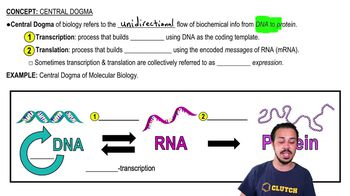
The Central Dogma of Molecular Biology describes the flow of genetic information within a biological system, typically summarized as DNA → RNA → Protein. This framework outlines how genetic information is first transcribed from DNA into RNA and then translated into proteins, which perform various functions in the cell. Understanding this concept is crucial for grasping how genes dictate cellular functions and traits.
Recommended video:
Guided course
05:45
Central Dogma
Related Practice
Textbook Question

Check your understanding of the flow of genetic information through a cell by filling in the blanks.

<IMAGE>

a.

b.

c.

d.

e.

f.

g.

h.

i.


2096
views
Textbook Question

Which of the following correctly ranks the structures in order of size, from largest to smallest?

a. Gene–Chromosome–Nucleotide–Codon

b. Chromosome–Gene–Codon–Nucleotide

c. Nucleotide–Chromosome–Gene–Codon

d. Chromosome–Nucleotide–Gene–Codon

1960
views
1
comments
Textbook Question
Describe the process of DNA replication: the ingredients needed, the steps in the process, and the final product.
2211
views
1
rank
Textbook Question

Scientists have discovered how to put together a bacteriophage with the protein coat of phage T2 and the DNA of phage lambda. If this composite phage were allowed to infect a bacterium, the phages produced in the host cell would have _________. (Explain your answer.)

a. The protein of T2 and the DNA of lambda

b. The protein of lambda and the DNA of T2

c. The protein and DNA of T2

d. The protein and DNA of lambda

1683
views
Textbook Question

A geneticist found that a particular mutation had no effect on the polypeptide encoded by a gene. This mutation probably involved

a. Deletion of one nucleotide

b. Alteration of the start codon

c. Insertion of one nucleotide

d. Substitution of one nucleotide

1799
views
Textbook Question
Describe the process by which the information in a eukaryotic gene is transcribed and translated into a protein. Correctly use these words in your description: tRNA, amino acid, start codon, transcription, RNA splicing, exons, introns, mRNA, gene, codon, RNA polymerase, ribosome, translation, anticodon, peptide bond, stop codon.
2002
views