
Pearson+ LogoPearson+ Logo
Ch. 10 Molecular Biology of the Gene
Taylor - Campbell Biology: Concepts & Connections 10th Edition
Taylor, Simon, Dickey, Hogan10th EditionCampbell Biology: Concepts & ConnectionsISBN: 9780136538783Not the one you use?Change textbook
Chapter 10, Problem 1

Check your understanding of the flow of genetic information through a cell by filling in the blanks.
<IMAGE>
a.
b.
c.
d.
e.
f.
g.
h.
i.

Verified step by step guidance
1
Step 1: Identify the monomers that make up DNA. DNA is a polymer made from monomers called nucleotides. These nucleotides consist of a sugar, a phosphate group, and a nitrogenous base.
Step 2: Determine the process that converts DNA into RNA. This process is called transcription, and it is performed by an enzyme called RNA polymerase.
Step 3: Recognize the three types of RNA. RNA comes in three kinds: messenger RNA (mRNA), transfer RNA (tRNA), and ribosomal RNA (rRNA).
Step 4: Understand the process that converts RNA into protein. This process is called translation, and it is performed by structures called ribosomes. Ribosomes use tRNA molecules to bring amino acids to the growing protein chain.
Step 5: Identify the monomers that make up proteins. Proteins are polymers made from monomers called amino acids, which are linked together by peptide bonds.

Verified video answer for a similar problem:

This video solution was recommended by our tutors as helpful for the problem above.
Video duration:
1m
Was this helpful?

Key Concepts

Here are the essential concepts you must grasp in order to answer the question correctly.

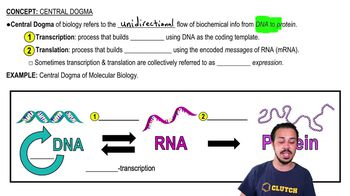
Central Dogma of Molecular Biology

The Central Dogma describes the flow of genetic information within a biological system, primarily through the processes of transcription and translation. It states that DNA is transcribed into RNA, which is then translated into proteins. This framework is essential for understanding how genetic instructions are converted into functional products in cells.
Recommended video:
Guided course
05:45
Central Dogma

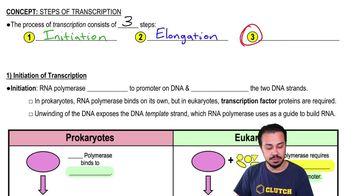
Transcription

Transcription is the process by which the genetic information encoded in DNA is copied into messenger RNA (mRNA). During transcription, RNA polymerase binds to the DNA at a specific region and synthesizes a complementary RNA strand. This step is crucial as it serves as the first stage in the expression of genes, leading to protein synthesis.
Recommended video:
Guided course
04:16
1) Initiation of Transcription

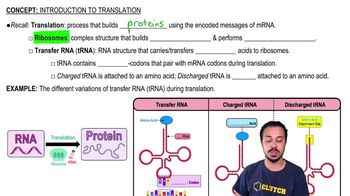
Translation

Translation is the process by which the sequence of nucleotides in mRNA is decoded to produce a specific polypeptide or protein. This occurs in the ribosome, where transfer RNA (tRNA) molecules bring amino acids that correspond to the codons in the mRNA sequence. Understanding translation is vital for grasping how proteins are synthesized and how they function in cellular processes.
Recommended video:
Guided course
06:12
Introduction to Translation