Pearson+ LogoPearson+ Logo
Ch. 10 Molecular Biology of the Gene
Taylor - Campbell Biology: Concepts & Connections 10th Edition
Taylor, Simon, Dickey, Hogan10th EditionCampbell Biology: Concepts & ConnectionsISBN: 9780136538783Not the one you use?Change textbook
Chapter 10, Problem 3

Describe the process of DNA replication: the ingredients needed, the steps in the process, and the final product.

Verified step by step guidance
1
Identify the ingredients needed for DNA replication: DNA polymerase enzymes, the original DNA molecule, free nucleotides (adenine, thymine, cytosine, guanine), and other enzymes like helicase and ligase.
Understand the initiation step: The enzyme helicase unwinds the double helix structure of the DNA, creating two single strands that serve as templates for the new DNA strands.
Learn about the elongation process: DNA polymerase attaches to each template strand and adds complementary nucleotides to the exposed bases. This enzyme works in the 5' to 3' direction, synthesizing a leading strand continuously and a lagging strand in short segments known as Okazaki fragments.
Recognize the role of ligase: After the DNA polymerase synthesizes the new DNA strands, the enzyme DNA ligase connects the Okazaki fragments on the lagging strand to form a continuous strand.
Identify the final product: Two new DNA molecules, each consisting of one original strand and one newly synthesized strand. This semi-conservative method of replication ensures genetic continuity across cell generations.

Verified video answer for a similar problem:

This video solution was recommended by our tutors as helpful for the problem above.
Video duration:
2m
Was this helpful?

Key Concepts

Here are the essential concepts you must grasp in order to answer the question correctly.

DNA Structure

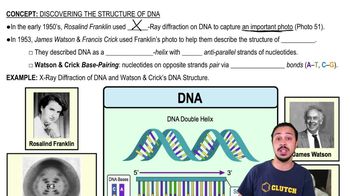
DNA, or deoxyribonucleic acid, is a double helix composed of nucleotides, each containing a phosphate group, a sugar, and a nitrogenous base. The sequence of these bases encodes genetic information. Understanding DNA structure is crucial for grasping how it replicates, as the two strands separate to serve as templates for new strands.
Recommended video:
Guided course
04:41
Discovering the Structure of DNA

Enzymes in DNA Replication

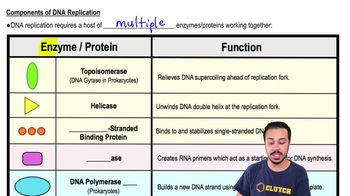
Several key enzymes facilitate DNA replication, including helicase, which unwinds the DNA double helix, and DNA polymerase, which synthesizes new DNA strands by adding nucleotides complementary to the template strand. Other enzymes, like ligase, join Okazaki fragments on the lagging strand, ensuring the integrity of the newly formed DNA.
Recommended video:
Guided course
04:47
Components of DNA Replication

Semiconservative Replication

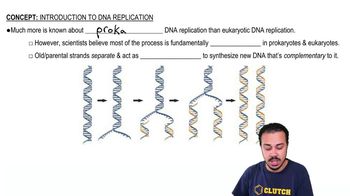
DNA replication is described as semiconservative because each new DNA molecule consists of one original strand and one newly synthesized strand. This mechanism ensures that genetic information is accurately passed on during cell division, maintaining the integrity of the genetic code across generations.
Recommended video:
Guided course
03:37
Introduction to DNA Replication