
In the light micrograph below of dividing cells near the tip of an onion root, identify a cell in interphase, prophase, metaphase, anaphase, and telophase. Describe the major events occurring at each stage. <IMAGE>
Verified step by step guidance
1
Examine the light micrograph carefully to identify cells in different stages of the cell cycle. Look for visual cues such as chromatin condensation, spindle formation, and chromosome alignment.
Identify a cell in interphase: Look for a cell with a clearly defined nucleus and chromatin that appears uncondensed. During interphase, the cell is preparing for division by replicating its DNA and organelles.
Identify a cell in prophase: Look for a cell where the chromatin has started to condense into visible chromosomes, and the nuclear envelope begins to break down. Spindle fibers may start forming.
Identify a cell in metaphase: Look for a cell where the chromosomes are aligned along the metaphase plate (the center of the cell). Spindle fibers are fully formed and attached to the centromeres of the chromosomes.
Identify a cell in anaphase and telophase: For anaphase, look for a cell where sister chromatids are being pulled apart toward opposite poles of the cell. For telophase, look for a cell where the chromosomes have reached the poles, the nuclear envelope is reforming, and the cell is preparing to divide into two daughter cells.
Verified video answer for a similar problem:
This video solution was recommended by our tutors as helpful for the problem above
Video duration:
1m
Play a video:
Was this helpful?
Key Concepts
Here are the essential concepts you must grasp in order to answer the question correctly.
Cell Cycle Stages
The cell cycle consists of several stages that a cell goes through to divide and replicate. These stages include interphase, where the cell prepares for division, and the mitotic phases: prophase, metaphase, anaphase, and telophase. Understanding these stages is crucial for identifying the specific events and characteristics of cells during division.
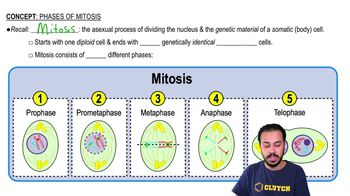
Mitosis is the process of nuclear division that results in two identical daughter cells. It is divided into several phases: prophase (chromosomes condense and become visible), metaphase (chromosomes align at the cell's equator), anaphase (sister chromatids are pulled apart), and telophase (nuclear membranes reform around the separated chromosomes). Each phase has distinct morphological features that can be observed under a microscope.
Chromosomes are structures made of DNA and proteins that carry genetic information. During cell division, they undergo significant changes in structure, becoming more condensed and visible during prophase. Understanding chromosome structure and behavior during mitosis is essential for identifying the stages of cell division and the events that occur at each stage.