
Pearson+ LogoPearson+ Logo
Ch. 8 The Cellular Basis of Reproduction and Inheritance
Taylor - Campbell Biology: Concepts & Connections 10th Edition
Taylor, Simon, Dickey, Hogan10th EditionCampbell Biology: Concepts & ConnectionsISBN: 9780136538783Not the one you use?Change textbook
Chapter 8, Problem 11

Why are individuals with an extra chromosome 21, which causes Down syndrome, more numerous than individuals with an extra chromosome 3 or chromosome 16?
a. There are probably more genes on chromosome 21 than on the others.
b. Chromosome 21 is a sex chromosome, and chromosomes 3 and 16 are not.
c. Down syndrome is not more common, just more serious.
d. Extra copies of the other chromosomes are probably fatal.

Verified step by step guidance
1
Understand the problem: The question is asking why individuals with an extra chromosome 21 (causing Down syndrome) are more numerous compared to individuals with an extra chromosome 3 or 16. The options provided suggest different reasons, and we need to evaluate them based on biological principles.
Step 1: Recall the concept of aneuploidy. Aneuploidy refers to the presence of an abnormal number of chromosomes in a cell. Trisomy is a type of aneuploidy where there is an extra copy of a chromosome (e.g., Trisomy 21 in Down syndrome).
Step 2: Consider the effects of gene dosage. Each chromosome contains many genes, and having an extra copy of a chromosome increases the expression of those genes. This can disrupt normal cellular function. Larger chromosomes (like chromosomes 3 and 16) have more genes, so an extra copy of these chromosomes would likely cause more severe disruptions, potentially leading to early embryonic lethality.
Step 3: Evaluate the options. Option (a) suggests that chromosome 21 has more genes, but this is incorrect because chromosome 21 is one of the smallest human chromosomes. Option (b) is incorrect because chromosome 21 is not a sex chromosome. Option (c) is incorrect because Down syndrome is more common, not just more serious. Option (d) aligns with the idea that extra copies of larger chromosomes (like 3 and 16) are more likely to be fatal due to the higher gene dosage effect.
Step 4: Conclude that the most plausible explanation is option (d): Extra copies of chromosomes 3 and 16 are likely fatal, which is why individuals with Trisomy 21 (Down syndrome) are more numerous.

Verified video answer for a similar problem:

This video solution was recommended by our tutors as helpful for the problem above.
Video duration:
1m
Was this helpful?

Key Concepts

Here are the essential concepts you must grasp in order to answer the question correctly.

Chromosomal Abnormalities

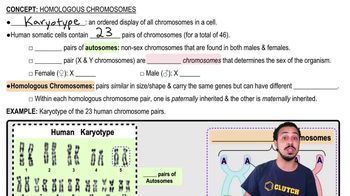
Chromosomal abnormalities occur when there is a deviation from the normal number or structure of chromosomes. In the case of Down syndrome, individuals have an extra copy of chromosome 21, leading to a total of three copies instead of the usual two. This condition, known as trisomy 21, is one of the most common chromosomal disorders and is associated with various developmental and health challenges.
Recommended video:
Guided course
08:09
Homologous Chromosomes

Gene Dosage and Viability

Gene dosage refers to the number of copies of a particular gene present in a cell or organism. An extra chromosome can lead to an imbalance in gene dosage, which can disrupt normal development. Chromosomes 3 and 16 contain genes that, when present in excess, may result in severe developmental issues that are often incompatible with life, leading to higher rates of miscarriage or stillbirth compared to trisomy 21.
Recommended video:
Guided course
05:02
Genes & Alleles

Prevalence of Down Syndrome

Down syndrome is one of the most prevalent chromosomal disorders, with an incidence of approximately 1 in 700 live births. The relative viability of individuals with trisomy 21 compared to those with other chromosomal trisomies contributes to its higher prevalence. While other trisomies may lead to more severe outcomes, the presence of an extra chromosome 21 allows for a greater number of individuals to survive to birth and beyond.
Recommended video:
Guided course
04:19
Building & Breaking-Down Polymers