Pearson+ LogoPearson+ Logo
Ch. 8 The Cellular Basis of Reproduction and Inheritance
Taylor - Campbell Biology: Concepts & Connections 10th Edition
Taylor, Simon, Dickey, Hogan10th EditionCampbell Biology: Concepts & ConnectionsISBN: 9780136538783Not the one you use?Change textbook
Chapter 8, Problem 10

Cytochalasin B is a chemical that disrupts microfilament formation. This chemical would interfere with:
a. DNA replication
b. Formation of the mitotic spindle
c. Cleavage
d. Formation of the cell plate

Verified step by step guidance
1
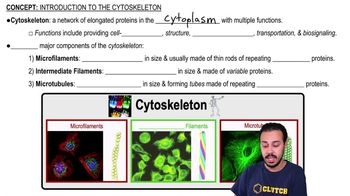
Understand the role of microfilaments in the cell. Microfilaments are part of the cytoskeleton and are primarily composed of actin. They play a key role in maintaining cell shape, enabling cell movement, and facilitating processes like cytokinesis during cell division.
Analyze the options provided in the question. Each option represents a cellular process: DNA replication, formation of the mitotic spindle, cleavage, and formation of the cell plate. Determine which of these processes relies on microfilaments.
Recall that DNA replication occurs in the nucleus and is primarily dependent on enzymes like DNA polymerase, not microfilaments. Therefore, cytochalasin B would not interfere with DNA replication.
Consider the formation of the mitotic spindle. The mitotic spindle is composed of microtubules, not microfilaments. Cytochalasin B disrupts microfilaments, so it would not interfere with spindle formation.
Evaluate cleavage and formation of the cell plate. Cleavage (cytokinesis in animal cells) involves the contractile ring, which is made of actin microfilaments. Formation of the cell plate (cytokinesis in plant cells) involves vesicle fusion and is not directly dependent on microfilaments. Therefore, cytochalasin B would interfere with cleavage.

Verified video answer for a similar problem:

This video solution was recommended by our tutors as helpful for the problem above.
Video duration:
2m
Was this helpful?

Key Concepts

Here are the essential concepts you must grasp in order to answer the question correctly.

Microfilaments

Microfilaments are thin, thread-like structures made of actin that are part of the cytoskeleton in eukaryotic cells. They play crucial roles in maintaining cell shape, enabling cell movement, and facilitating cell division. Disruption of microfilament formation can significantly affect cellular processes, particularly those involving changes in cell shape and motility.
Recommended video:
Guided course
06:05
Introduction to the Cytoskeleton

Cytokinesis

Cytokinesis is the process during cell division where the cytoplasm of a parental cell is divided into two daughter cells. In animal cells, this involves the formation of a cleavage furrow, which is driven by the contraction of microfilaments. Disruption of microfilament formation by Cytochalasin B would hinder this process, preventing proper cell division.
Recommended video:

Cell Plate Formation

In plant cells, cell plate formation is a critical step during cytokinesis, where vesicles containing cell wall materials fuse at the center of the dividing cell to form a new cell wall. This process is also dependent on the cytoskeleton, including microfilaments, to guide the vesicles to the correct location. Disruption of microfilament formation would impair the ability to form a cell plate, affecting plant cell division.
Recommended video:
Guided course
04:33
Plate Tectonics and Continental Drift
Related Practice
Textbook Question

Which of the following phases of mitosis is essentially the opposite of prophase in terms of changes within the nucleus?

a. Telophase

b. Metaphase

c. Interphase

d. Anaphase

1871
views
Textbook Question

A biochemist measured the amount of DNA in cells growing in the laboratory and found that the quantity of DNA in a cell doubled

a. Between prophase and anaphase of mitosis

b. Between the G1 and G2 phases of the cell cycle

c. During the M phase of the cell cycle

d. Between prophase I and prophase II of meiosis

1791
views
Textbook Question

A micrograph of a dividing cell from a mouse showed 19 chromosomes, each consisting of two sister chromatids. During which of the following stages of cell division could such a picture have been taken? (Explain your answer.)

a. Prophase of mitosis

b. Telophase II of meiosis

c. Prophase I of meiosis

d. Prophase II of meiosis

1517
views
Textbook Question

Why are individuals with an extra chromosome 21, which causes Down syndrome, more numerous than individuals with an extra chromosome 3 or chromosome 16?

a. There are probably more genes on chromosome 21 than on the others.

b. Chromosome 21 is a sex chromosome, and chromosomes 3 and 16 are not.

c. Down syndrome is not more common, just more serious.

d. Extra copies of the other chromosomes are probably fatal.

2229
views
Textbook Question

In the light micrograph below of dividing cells near the tip of an onion root, identify a cell in interphase, prophase, metaphase, anaphase, and telophase. Describe the major events occurring at each stage.

<IMAGE>

3004
views
Textbook Question
An organism called a plasmodial slime mold is one large cytoplasmic mass with many nuclei. Explain how such a 'megacell' could form.
1890
views