
What two functional groups are bound to the central carbon of every free amino acid monomer? a. An R-group and a hydroxyl group b. An N—H group and a (C═O) group c. An amino group and a hydroxyl group d. An amino group and a carboxyl group
Verified step by step guidance
1
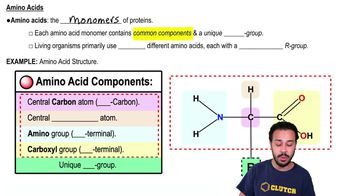
Step 1: Understand the structure of an amino acid. Every amino acid has a central carbon atom (called the alpha carbon) to which four different groups are attached: an amino group (-NH₂), a carboxyl group (-COOH), a hydrogen atom, and a variable R-group (side chain).
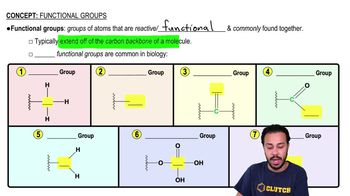
Step 2: Analyze the functional groups mentioned in the question. Functional groups are specific groups of atoms within molecules that are responsible for the characteristic chemical reactions of those molecules. In amino acids, the amino group (-NH₂) and the carboxyl group (-COOH) are the two key functional groups bound to the central carbon.
Step 3: Eliminate incorrect options by comparing the functional groups in each answer choice to the structure of an amino acid. For example, a hydroxyl group (-OH) is not one of the functional groups directly attached to the central carbon of an amino acid.
Step 4: Confirm that the correct answer is the one that includes both the amino group (-NH₂) and the carboxyl group (-COOH), as these are the defining functional groups of amino acids.
Step 5: Select the correct answer, which is 'd. an amino group and a carboxyl group,' based on the structural characteristics of amino acids.
Verified video answer for a similar problem:
This video solution was recommended by our tutors as helpful for the problem above
Video duration:
2m
Play a video:
Was this helpful?
Key Concepts
Here are the essential concepts you must grasp in order to answer the question correctly.
Amino Acids
Amino acids are organic compounds that serve as the building blocks of proteins. Each amino acid consists of a central carbon atom bonded to four different groups: an amino group (—NH2), a carboxyl group (—COOH), a hydrogen atom, and a variable R-group that determines the specific properties of the amino acid.
Functional groups are specific groups of atoms within molecules that are responsible for the characteristic chemical reactions of those molecules. In amino acids, the two key functional groups are the amino group, which acts as a base, and the carboxyl group, which acts as an acid, allowing amino acids to participate in peptide bond formation.
Peptide bonds are covalent bonds that link amino acids together to form proteins. This bond forms between the carboxyl group of one amino acid and the amino group of another, releasing a molecule of water in a dehydration synthesis reaction. Understanding peptide bonds is crucial for grasping how proteins are synthesized and function in biological systems.