Skip to main content
General Biology
My Course
Learn
Exam Prep
AI Tutor
Study Guides
Textbook Solutions
Flashcards
Explore
Try the app
My Course
Learn
Exam Prep
AI Tutor
Study Guides
Textbook Solutions
Flashcards
Explore
Try the app
Back
ATP exam
You can tap to flip the card.
ATP
You can tap to flip the card.
👆
ATP
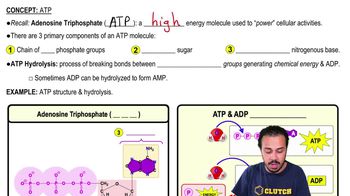
Adenosine triphosphate, a high-energy molecule used to power cellular activities.
Track progress
Control buttons has been changed to "navigation" mode.
1/29
Related flashcards
Related practice
Recommended videos
ATP definitions
ATP
6 Terms
ATP quiz #1
ATP
22 Terms
ATP quiz #2
ATP
40 Terms
ATP
7. Energy and Metabolism
3 problems
Topic
Jason
Enzymes
7. Energy and Metabolism
6 problems
Topic
Jason
7. Energy and Metabolism
10 topics
13 problems
Chapter
Brendan
04:57
Energy Coupling
18943
views
238
rank
1
comments
06:43
ATP
24156
views
374
rank
3
comments
03:
Phosphorylation
17391
views
379
rank
Terms in this set (29)
Hide definitions
ATP
Adenosine triphosphate, a high-energy molecule used to power cellular activities.
What are the three components of ATP?
Three phosphate groups, a pentose sugar, and an adenine base.
ATP Hydrolysis
The process of breaking bonds between phosphate groups in ATP, releasing energy.
What does ATP hydrolysis produce?
ADP (adenosine diphosphate) and a phosphate group.
Phosphorylation
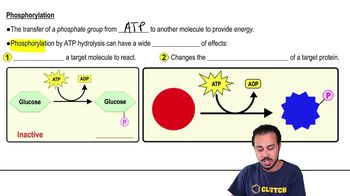
The transfer of a phosphate group from ATP to another molecule.
What is the role of phosphorylation?
It can activate or alter target molecules, influencing their function.
Energy Coupling
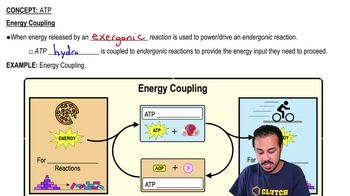
Using energy released by an exergonic reaction to drive an endergonic reaction.
What is an example of an exergonic reaction?
ATP hydrolysis.
ADP
Adenosine diphosphate, a molecule with two phosphate groups formed after ATP hydrolysis.
What happens during ATP hydrolysis?
Energy is released, and ATP is converted to ADP and a phosphate group.
AMP
Adenosine monophosphate, a molecule with one phosphate group.
What is the significance of ATP in muscle contractions?
ATP hydrolysis provides the energy needed for muscle contractions.
Pentose Sugar
A five-carbon sugar component of ATP.
What does the 'tri' in triphosphate indicate?
It indicates the presence of three phosphate groups in ATP.
Adenine Base
A nitrogenous base that is part of the adenosine in ATP.
What is the result of phosphorylation on a protein?
It can change the protein's shape and function.
Exergonic Reaction
A reaction that releases energy.
What is the role of water in ATP hydrolysis?
Water is used to break the bonds between phosphate groups.
Endergonic Reaction
A reaction that requires an input of energy.
What does the 'di' in diphosphate indicate?
It indicates the presence of two phosphate groups in ADP.
How is ATP related to food energy?
Energy from food is converted into chemical energy in the form of ATP.
What does the 'mono' in monophosphate indicate?
It indicates the presence of one phosphate group in AMP.
What is the function of the energy released from ATP hydrolysis?
It powers other chemical reactions and cellular activities.
What is the effect of phosphorylation on glucose?
It activates glucose, making it capable of reacting.
What is the relationship between ATP and ADP?
ATP is converted to ADP through hydrolysis, releasing energy.
What is the significance of the adenine base in ATP?
It is part of the adenosine component of ATP.
What is the role of ATP in cellular activities?
ATP provides the energy needed for various cellular processes.
What happens to the phosphate group released during ATP hydrolysis?
It can be attached to another molecule or released into the cell.
What is the importance of understanding ATP processes?
It is crucial for grasping cellular energy dynamics and metabolic pathways.
 BackBack

 04:57
04:57