Skip to main content
General Biology
My Course
Learn
Exam Prep
AI Tutor
Study Guides
Textbook Solutions
Flashcards
Explore
Try the app
My Course
Learn
Exam Prep
AI Tutor
Study Guides
Textbook Solutions
Flashcards
Explore
Try the app
Back
Central and Peripheral Nervous System exam
You can tap to flip the card.
Central Nervous System (CNS)
You can tap to flip the card.
👆
Central Nervous System (CNS)
Comprises the brain and spinal cord.
Track progress
Control buttons has been changed to "navigation" mode.
1/30
Related flashcards
Related practice
Recommended videos
Central and Peripheral Nervous System definitions
Central and Peripheral Nervous System
9 Terms
Central and Peripheral Nervous System quiz #1
Central and Peripheral Nervous System
15 Terms
Central and Peripheral Nervous System quiz #1
Central and Peripheral Nervous System
10 Terms
Central and Peripheral Nervous System
45. Nervous System
7 problems
Topic
Jason
Neurons and Action Potentials
45. Nervous System
7 problems
Topic
Jason
45. Nervous System
2 topics
6 problems
Chapter
Jason
04:07
Motor, Sensory, and Association Areas
3083
views
14
rank
11:10
Cerebrum and Cerebral Cortex
3065
views
19
rank
06:26
Peripheral Nervous System
2915
views
14
rank
Terms in this set (30)
Hide definitions
Central Nervous System (CNS)
Comprises the brain and spinal cord.
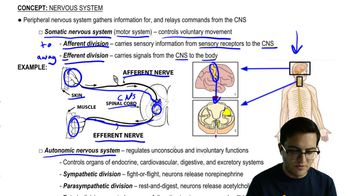
Peripheral Nervous System (PNS)
Relays information to and from the CNS and is divided into the somatic and autonomic systems.
What is the function of the blood-brain barrier?
It isolates the CNS from toxins and pathogens in the blood.
Gray Matter
Consists mostly of neuron cell bodies and is found on the outside of the brain and inside the spinal cord.
White Matter
Consists mostly of myelinated axons and is found inside the brain and on the outside of the spinal cord.
What are tracts in the CNS?
Bundles of axons traveling together within the CNS.
Reflex Arc
A neural pathway that controls an involuntary response to a stimulus, bypassing the brain.
Somatic Nervous System
Controls voluntary movements and includes afferent and efferent divisions.
Autonomic Nervous System
Regulates involuntary functions and includes the sympathetic and parasympathetic divisions.
What neurotransmitter is released by the sympathetic division?
Norepinephrine.
What neurotransmitter is released by the parasympathetic division?
Acetylcholine.
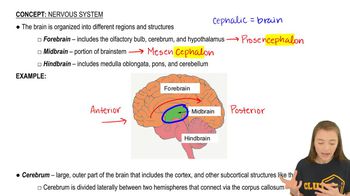
Forebrain
Includes the cerebrum, hypothalamus, and olfactory bulb; responsible for functions like sensory processing and motor control.
Midbrain
Part of the brainstem that connects the forebrain to the hindbrain and is involved in eye movement and visual processing.
Hindbrain
Includes the medulla oblongata, pons, and cerebellum; connects the brain to the spinal cord and controls basic life functions.
Cerebrum
The largest part of the brain, responsible for thinking, planning, and reasoning.
Corpus Callosum
A bundle of nerve fibers that connects the left and right hemispheres of the brain.
What is the function of the primary motor cortex?
Plans and executes voluntary movements.
Primary Somatosensory Cortex
Processes sensory information from the body.
Occipital Lobe
Processes visual information.
Temporal Lobe
Involved in hearing, language, and visual processing.
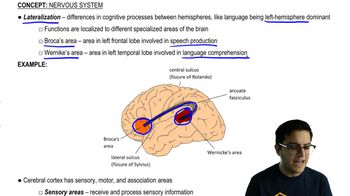
What is lateralization in the brain?
The specialization of functions in the left and right hemispheres.
Broca's Area
Involved in speech production and located in the frontal lobe.
Wernicke's Area
Involved in language comprehension and located in the temporal lobe.
Thalamus
Acts as a relay center for sensory information in the brain.
Hypothalamus
Links the nervous system to the endocrine system and is involved in homeostasis.
Hippocampus
Involved in the formation of long-term and spatial memory.
Amygdala
Involved in emotional processing.
Cerebellum
Coordinates motor functions and maintains posture and balance.
Neuroplasticity
The brain's ability to reorganize itself by forming new neural connections.
Long-Term Potentiation
The long-term strengthening of synapses based on activity patterns, involved in learning and memory.
 BackBack
 04:07
04:07