Skip to main content
General Biology
My Course
Learn
Exam Prep
AI Tutor
Study Guides
Textbook Solutions
Flashcards
Explore
Try the app
My Course
Learn
Exam Prep
AI Tutor
Study Guides
Textbook Solutions
Flashcards
Explore
Try the app
Back
Growth exam
You can tap to flip the card.
Indeterminate growth
You can tap to flip the card.
👆
Indeterminate growth
Growth that continues throughout a plant's life.
Track progress
Control buttons has been changed to "navigation" mode.
1/29
Related flashcards
Related practice
Recommended videos
Growth quiz #1
Growth
26 Terms
Growth definitions
Growth
13 Terms
Growth quiz #2
Growth
10 Terms
Growth
33. Plant Anatomy
7 problems
Topic
Jason
Tissues
33. Plant Anatomy
3 problems
Topic
Jason
33. Plant Anatomy
3 topics
7 problems
Chapter
Jason
05:29
Root Growth
3027
views
17
rank
07:52
Primary Meristems
3150
views
14
rank
06:52
Secondary Growth
3133
views
16
rank
Terms in this set (29)
Hide definitions
Indeterminate growth
Growth that continues throughout a plant's life.
What are meristems?
Collections of plant stem cells that differentiate into various tissues.
Primary growth
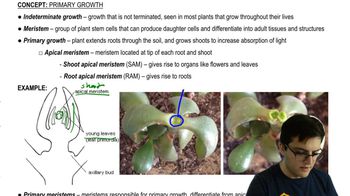
Growth that extends roots and shoots, occurring at apical meristems.
Where does secondary growth occur?
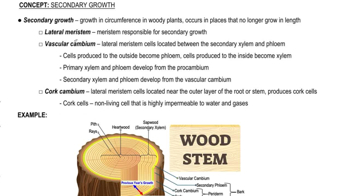
In woody plants, involving lateral meristems like vascular cambium and cork cambium.
Vascular cambium
A lateral meristem that produces secondary xylem and phloem.
What is the function of cork cambium?
Forms bark by producing cork cells.
Root hairs
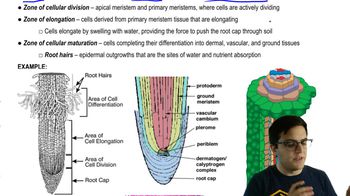
Epidermal outgrowths essential for nutrient absorption.
What are the three zones of root growth?
Zones of cellular division, elongation, and maturation.
Apical meristem
Meristem located at the tip of each root and shoot.
What does the protoderm give rise to?
The epidermis.
Procambium
Primary meristem that gives rise to vascular tissue.
What is the ground meristem responsible for?
Giving rise to ground tissue.
Zone of cellular division
Area where cells are actively dividing, found behind the root cap.
What happens in the zone of elongation?
Cells elongate by swelling with water, pushing the root cap through the soil.
Zone of cellular maturation
Area where cells complete their differentiation into various tissue types.
What is the role of the root cap?
Protects the apical meristem and senses gravity.
Secondary xylem
Produced by the vascular cambium, contributing to growth rings.
What is heartwood?
The inner, non-transporting xylem that accumulates gums and resins.
Sapwood
The outer, actively transporting xylem.
What forms bark?
Cork cells produced by the cork cambium and secondary phloem.
Lenticles
Porous tissues in bark that allow for gas exchange.
What is the shoot apical meristem?
The apical meristem located at the tip of a shoot, giving rise to leaves and flowers.
Root apical meristem
The apical meristem located at the tip of a root, giving rise to roots.
What are primary meristems?
Meristems that differentiate from apical meristems and are responsible for primary growth.
Ground tissue
Tissue that is not vascular or dermal, derived from the ground meristem.
What is the function of secondary phloem?
Produced by the vascular cambium, it contributes to the formation of bark.
What is the role of the vascular cambium in secondary growth?
Produces secondary xylem and phloem, contributing to the plant's circumference.
Cork cells
Non-living cells produced by the cork cambium, forming bark.
What is the significance of growth rings in trees?
They indicate the age of the tree and are formed by the accumulation of secondary xylem.
 BackBack
 05:29
05:29