What is the primary function of topoisomerase in DNA replication?
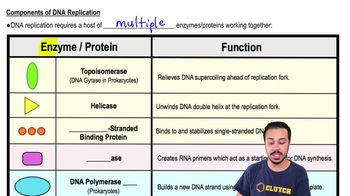
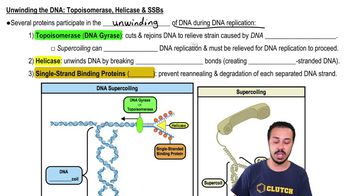
Topoisomerase relieves DNA supercoiling ahead of the replication fork.
What role does helicase play in DNA replication?
Helicase unwinds the DNA double helix at the replication fork by breaking hydrogen bonds.
What is the function of single-stranded binding proteins (SSBs) during DNA replication?
SSBs bind to and stabilize single-stranded DNA to prevent reannealing and degradation.
What is the purpose of RNA primers in DNA replication?
RNA primers, created by primase, act as starting points for DNA synthesis.
Which enzyme is responsible for building new DNA strands in prokaryotes?
DNA Polymerase III is the main enzyme responsible for building new DNA strands in prokaryotes.
What is the function of DNA Polymerase I in prokaryotic DNA replication?
DNA Polymerase I replaces RNA primers with DNA.
What is the role of DNA ligase in DNA replication?
DNA ligase covalently joins Okazaki fragments on the lagging strand.
Where does DNA replication begin in prokaryotic cells?
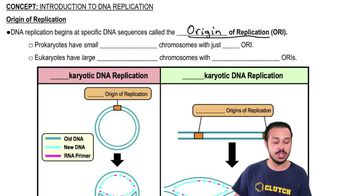
DNA replication begins at a single origin of replication on the circular chromosome.
How many origins of replication do eukaryotic chromosomes typically have?
Eukaryotic chromosomes have multiple origins of replication, sometimes up to 100 or more.
What is a replication fork?
A replication fork is a Y-shaped region where DNA is unwound and replication occurs.
In which direction does DNA replication proceed at the replication fork?
DNA replication proceeds bidirectionally at each replication fork.
What is the significance of the 5' to 3' direction in DNA synthesis?
New DNA strands are always synthesized in the 5' to 3' direction.
What is DNA supercoiling and why must it be relieved during replication?
DNA supercoiling is the over-twisting of DNA, which must be relieved to prevent inhibition of DNA replication.
What is the function of DNA gyrase in prokaryotes?
DNA gyrase, a type of topoisomerase, relieves DNA supercoiling in prokaryotes.
What is the role of primase in DNA replication?
Primase synthesizes RNA primers that provide a starting point for DNA polymerase.
after dna replication is completed, _____.
two identical DNA molecules are formed, each consisting of one old (parental) strand and one newly synthesized strand, due to the semi-conservative nature of DNA replication.
dna is a self-replicating molecule. what accounts for this important property of dna?
The self-replicating property of DNA is due to its double-stranded structure, where each strand serves as a template for the synthesis of a new complementary strand, facilitated by base pairing rules.
the action of helicase creates _____.
The action of helicase creates single-stranded DNA by unwinding the double helix and breaking the hydrogen bonds between the two DNA strands.
What are the steps in DNA replication?
Steps in DNA replication include initiation at the origin of replication, unwinding of DNA by helicase, stabilization of single strands by single-strand binding proteins, synthesis of RNA primers by primase, elongation of new DNA strands by DNA polymerase, and joining of Okazaki fragments by DNA ligase.
replication of chromosomal dna occurs __________.
Replication of chromosomal DNA occurs bidirectionally from multiple origins of replication in eukaryotes and from a single origin in prokaryotes.
the first step in the replication of dna is catalyzed by _____.
The first step in the replication of DNA is catalyzed by helicase, which unwinds the DNA double helix at the replication fork.
 Back
Back

 05:10
05:10