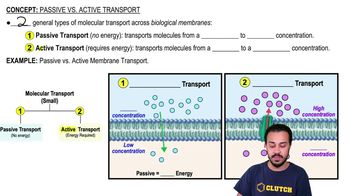
The process of moving molecules against their concentration gradient using energy, typically ATP, and requiring transport proteins.
Passive Transport
Movement of molecules across a cell membrane without energy input, following the concentration gradient, sometimes utilizing transport proteins.
Cell Membrane
A selective barrier that regulates the entry and exit of substances, maintaining homeostasis through active and passive transport mechanisms.
Concentration Gradient
The gradual difference in the concentration of solutes in a solution between two regions, leading to the movement of particles from high to low concentration.
Atp
A molecule that provides energy for cellular processes, especially active transport, by releasing energy when its phosphate bonds are broken.
Transport Proteins
Proteins that facilitate the movement of substances across cell membranes, either passively without energy or actively with ATP, often moving molecules against their concentration gradient.
Symporter
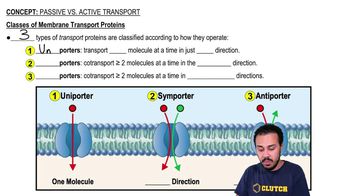
A transport protein that moves two different molecules in the same direction across a cell membrane, often using energy (ATP) for active transport.
Uniporter
A transport protein that facilitates the movement of a single type of molecule across a cell membrane without requiring energy.
Energy
The capacity to perform work or cause change, often required for active transport processes in cells, typically derived from ATP.
Cellular Transport
Movement of substances across a cell membrane, either requiring energy (active) or not (passive), to maintain homeostasis and facilitate cellular functions.
Molecules
Molecules: Chemical structures consisting of two or more atoms bonded together, fundamental to biological processes and cellular functions.
Communication
The process by which cells exchange information through chemical signals, electrical signals, or direct contact to coordinate functions and responses.
Substances
Substances: Materials or molecules that are transported across cell membranes via active (energy-requiring) or passive (non-energy-requiring) transport mechanisms.
Transporter
A protein that facilitates the movement of molecules across a cell membrane, either requiring energy (active) or not (passive), and can transport one or multiple molecules simultaneously.
 Back
Back

 03:28
03:28