Introduction to Population Ecology exam Flashcards

Introduction to Population Ecology exam
1 student found this helpful
Control buttons has been changed to "navigation" mode.
1/29
  • Population Ecology
    The study of how populations change over time, focusing on metrics like population size and population density.
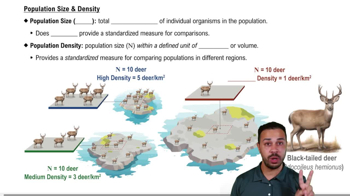
  • What is population size?
    The total number of individual organisms in a population, commonly abbreviated as 'n'.
  • Population Density
    The number of individuals per unit area or volume, providing a sense of how crowded a population is.
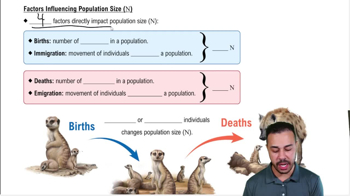
  • What factors increase population size?
    Births and immigration.
  • What factors decrease population size?
    Deaths and emigration.
  • Metapopulation
    A group of spatially separated local populations linked by migration.
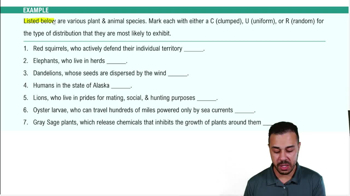
  • What is a clumped dispersion pattern?
    Individuals are aggregated in patches or groups, often due to resource availability or social behaviors.
  • Uniform Dispersion
    Individuals are evenly spaced from one another, often due to territorial behavior.
  • Random Dispersion
    Individuals are spaced unpredictably, often seen in plants with wind-dispersed seeds.
  • What is the significance of population boundaries?
    They define the area of interest for studying a population, which can be naturally or arbitrarily set.
  • How does population density differ from population size?
    Population density considers the area occupied, providing a standardized measure for comparison, while population size is a simple count.
  • What is the role of immigration in a metapopulation?
    It links local populations, allowing recolonization if a local population goes extinct.
  • Why are metapopulations more stable than local populations?
    Because they can recolonize areas where local populations have gone extinct, reducing the risk of species extinction.
  • What is the most common pattern of dispersion?
    Clumped dispersion.
  • How can the scale of observation affect the perceived dispersion pattern?
    Zooming in on a clumped patch might reveal a uniform pattern, showing that dispersion depends on the observation scale.
  • What is the impact of births on population size?
    Births increase population size.
  • What is the impact of deaths on population size?
    Deaths decrease population size.
  • What is the impact of emigration on population size?
    Emigration decreases population size.
  • What is the impact of immigration on population size?
    Immigration increases population size.
  • Why might organisms exhibit a clumped dispersion pattern?
    Due to resource availability or social behaviors like hunting in packs.
  • Why might organisms exhibit a uniform dispersion pattern?
    Due to territorial behavior and the need for personal space.
  • Why might organisms exhibit a random dispersion pattern?
    Often due to random dispersal mechanisms like wind-dispersed seeds.
  • What is the importance of defining population boundaries?
    It allows ecologists to gather focused data on a specific population.
  • How does population density provide a standardized measure?
    By considering the area occupied, it allows for comparisons across different regions.
  • What happens if a local population in a metapopulation goes extinct?
    It can be recolonized by individuals from other local populations within the metapopulation.
  • What is the relationship between population density and crowding?
    Higher population density indicates more crowding, while lower density indicates less crowding.
  • How do births and immigration affect population size?
    Both increase population size.
  • How do deaths and emigration affect population size?
    Both decrease population size.
  • What is the role of migration in metapopulations?
    It links local populations, enhancing stability and reducing extinction risk.