Skip to main content
General Biology
My Course
Learn
Exam Prep
AI Tutor
Study Guides
Textbook Solutions
Flashcards
Explore
Try the app
My Course
Learn
Exam Prep
AI Tutor
Study Guides
Textbook Solutions
Flashcards
Explore
Try the app
Back
Properties of Water- Thermal exam
1 student found this helpful
You can tap to flip the card.
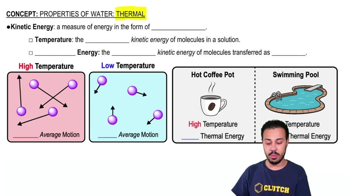
Kinetic Energy
You can tap to flip the card.
👆
Kinetic Energy
Energy in the form of motion.
Track progress
Control buttons has been changed to "navigation" mode.
1/29
Related flashcards
Related practice
Recommended videos
Properties of Water- Thermal definitions
Properties of Water- Thermal
7 Terms
Properties of Water- Thermal quiz #1
Properties of Water- Thermal
17 Terms
Properties of Water- Thermal quiz #2
Properties of Water- Thermal
21 Terms
Properties of Water- Thermal
3. Water
5 problems
Topic
Jason
Properties of Water- The Universal Solvent
3. Water
4 problems
Topic
Jason
3. Water
7 topics
9 problems
Chapter
Jason
04:07
Properties of Water- Thermal
18739
views
298
rank
03:25
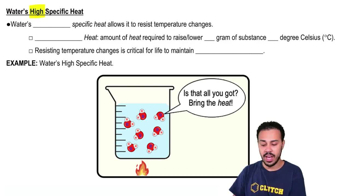
Water’s High Specific Heat
17534
views
276
rank
03:31
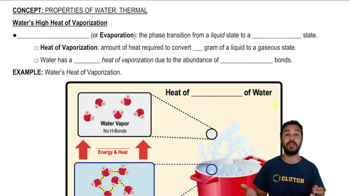
Water’s High Heat of Vaporization
17360
views
250
rank
Terms in this set (29)
Hide definitions
Kinetic Energy
Energy in the form of motion.
What is specific heat?
The amount of heat energy required to raise or lower the temperature of 1 gram of water by 1°C.
Temperature
The average kinetic energy of molecules in a sample.
What does high specific heat allow water to do?
Resist temperature changes.
Thermal Energy
The total kinetic energy of molecules transferred as heat.
What is heat of vaporization?
The amount of heat required to convert 1 gram of liquid water to gas.
High Specific Heat
Water's property that requires a high amount of energy to change its temperature.
Why is water's high specific heat important for living organisms?
It helps maintain homeostasis by resisting temperature fluctuations.
Hydrogen Bonds
Bonds that form between water molecules, influencing water's thermal properties.
What happens to hydrogen bonds during vaporization?
They break, allowing water molecules to escape into the gaseous state.
Homeostasis
The ability to maintain a stable internal environment despite external changes.
Why does water have a high heat of vaporization?
Due to the abundance of hydrogen bonds that need to be broken.
Phase Transition
The change from one state of matter to another, such as liquid to gas.
What is the relationship between temperature and kinetic energy?
Temperature is the average kinetic energy of molecules.
Environmental Temperature Stabilization
Water's ability to stabilize temperatures, supporting life processes.
What is the significance of water's thermal properties?
They enable water to support cellular functions and life processes.
Heat of Vaporization
The energy required to convert liquid water to gas.
What does thermal energy depend on?
The total kinetic energy of all molecules in a sample.
Why does water resist temperature changes?
Because of its high specific heat.
Average Kinetic Energy
The average motion of molecules in a sample, measured as temperature.
What is the effect of water's high heat of vaporization on boiling?
It takes a lot of energy and time to boil water.
How does water's high specific heat affect the environment?
It helps stabilize environmental temperatures.
What is the role of hydrogen bonds in water's thermal properties?
They contribute to water's high specific heat and heat of vaporization.
Why is thermal energy higher in a swimming pool than in a hot coffee pot?
Because the swimming pool has a larger volume and more molecules.
What is the difference between temperature and thermal energy?
Temperature is the average kinetic energy, while thermal energy is the total kinetic energy transferred as heat.
How does water's high specific heat benefit cells?
It helps maintain constant temperatures inside cells.
What is the significance of hydrogen bonds in liquid water?
They require a lot of energy to break, contributing to water's high heat of vaporization.
How does water's high specific heat affect cooking?
It takes a long time to heat water to boiling point.
What is the impact of water's thermal properties on life?
They help maintain stable conditions necessary for life processes.
 BackBack
 04:07
04:07