Skip to main content
General Biology
My Course
Learn
Exam Prep
AI Tutor
Study Guides
Textbook Solutions
Flashcards
Explore
Try the app
My Course
Learn
Exam Prep
AI Tutor
Study Guides
Textbook Solutions
Flashcards
Explore
Try the app
Back
Protist Life Cycles quiz #1
You can tap to flip the card.
What is the dominant phase in a haploid dominant life cycle?
You can tap to flip the card.
👆
What is the dominant phase in a haploid dominant life cycle?
The dominant phase in a haploid dominant life cycle is the haploid phase.
Track progress
Control buttons has been changed to "navigation" mode.
1/15
Related flashcards
Related practice
Recommended videos
Protist Life Cycles definitions
Protist Life Cycles
15 Terms
Protist Life Cycles exam
Protist Life Cycles
27 Terms
Protist Life Cycles quiz #2
Protist Life Cycles
10 Terms
Protist Life Cycles
27. Protists
4 problems
Topic
KeyshawnDavis
Protist Lineages
27. Protists
7 problems
Topic
Jason
27. Protists
4 topics
6 problems
Chapter
Nicole
04:56
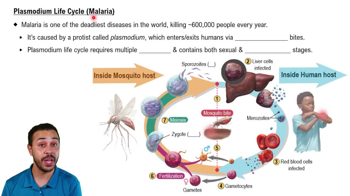
Plasmodium Life Cycle (Malaria)
2478
views
18
rank
06:28
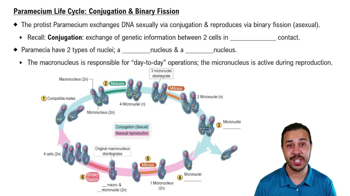
Paramecium Life Cycle: Conjugation & Asexual Reproduction
2762
views
13
rank
01:22
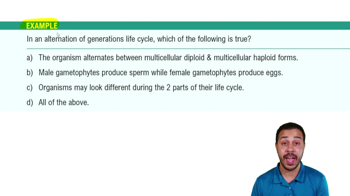
Protist Life Cycles Example 2
1916
views
14
rank
Terms in this set (15)
Hide definitions
What is the dominant phase in a haploid dominant life cycle?
The dominant phase in a haploid dominant life cycle is the haploid phase.
In a diploid dominant life cycle, what is the only haploid part of the organism's life cycle?
The only haploid part of the organism's life cycle in a diploid dominant life cycle is the gametes.
What process does the zygote undergo in a haploid dominant life cycle?
In a haploid dominant life cycle, the zygote undergoes meiosis to produce haploid cells.
What is the primary difference between haploid and diploid dominant life cycles?
In haploid dominant life cycles, the zygote undergoes meiosis, while in diploid dominant life cycles, the zygote undergoes mitosis.
Which group of unicellular eukaryotes lacks mitochondria and reproduces asexually?
The Excavata group of unicellular eukaryotes lacks mitochondria and reproduces asexually.
What unique feature do Diplomonads possess?
Diplomonads possess two nuclei and lack typical mitochondria.
How do Parabasalids move?
Parabasalids move using flagella and by undulating their membrane.
What is a mixotroph?
A mixotroph is an organism that is both photosynthetic and heterotrophic.
What pigment gives red algae their color, and what does it mask?
Red algae contain the pigment phycoerythrin, which masks the green color of chlorophyll.
What is the significance of primary endosymbiosis in Archaeplastida?
Primary endosymbiosis in Archaeplastida led to the engulfment of cyanobacterium, giving rise to green algae and land plants.
What are rhizomes and stolons in the context of asexual reproduction?
Rhizomes are underground stems that form new individuals, while stolons are above-ground stems that also produce new individuals.
What is apomixis in plant reproduction?
Apomixis is the formation of seeds without fertilization, resulting in genetically identical offspring.
What is the calyx in a flower?
The calyx is the entire group of sepals and the cup-like structure they connect to, providing protection for the flower bud.
What is the corolla in a flower?
The corolla is the entire group of petals in a flower, usually serving to attract pollinators.
What is vegetative propagation?
Vegetative propagation is a form of asexual reproduction involving human intervention, such as making cuttings to grow new plants.
 BackBack

 04:56
04:56