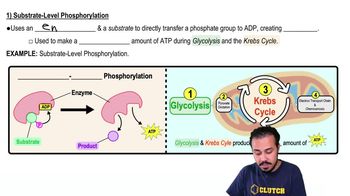
A type of phosphorylation that directly transfers a phosphate group to ADP using an enzyme, producing ATP during glycolysis and the Krebs cycle.
What is the main purpose of aerobic cellular respiration?
To generate a large amount of ATP for the cell.
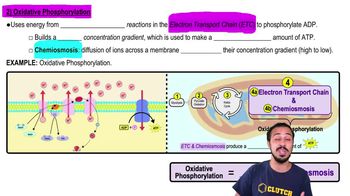
Oxidative phosphorylation
A type of phosphorylation that uses energy from redox reactions in the electron transport chain and chemiosmosis to produce a significant amount of ATP.
Where does substrate-level phosphorylation occur?
During glycolysis and the Krebs cycle.
Electron transport chain (ETC)
A series of protein complexes that transfer electrons through a membrane to create a proton gradient that drives ATP synthesis in oxidative phosphorylation.
What is chemiosmosis?
The diffusion of hydrogen ions across a membrane down their concentration gradient, used to generate ATP in oxidative phosphorylation.
How many ATP molecules are produced by substrate-level phosphorylation during glycolysis?
2 ATP molecules.
Redox reactions
Chemical reactions that involve the transfer of electrons between two species, crucial for energy production in oxidative phosphorylation.
What is the role of the enzyme in substrate-level phosphorylation?
To catalyze the transfer of a phosphate group from a substrate to ADP, forming ATP.
Hydrogen ion concentration gradient
A gradient formed by the electron transport chain that drives ATP synthesis during chemiosmosis.
Which stage of aerobic cellular respiration involves oxidative phosphorylation?
The fourth and final stage, which includes the electron transport chain and chemiosmosis.
How many ATP molecules are produced by substrate-level phosphorylation during the Krebs cycle?
2 ATP molecules.
What is the main takeaway about oxidative phosphorylation?
It produces the vast majority of ATP during aerobic cellular respiration.
ATP
Adenosine triphosphate, the primary energy carrier in cells.
What are the two main types of phosphorylation in aerobic cellular respiration?
Substrate-level phosphorylation and oxidative phosphorylation.
Glycolysis
The first stage of aerobic cellular respiration where glucose is broken down, producing a small amount of ATP via substrate-level phosphorylation.
What is the role of the electron transport chain in oxidative phosphorylation?
To create a hydrogen ion concentration gradient that drives ATP synthesis.
Krebs cycle
The third stage of aerobic cellular respiration that produces a small amount of ATP via substrate-level phosphorylation.
What is the significance of chemiosmosis in oxidative phosphorylation?
It utilizes the hydrogen ion concentration gradient to phosphorylate ADP, producing ATP.
ADP
Adenosine diphosphate, the low-energy form that is converted to ATP during phosphorylation.
What is the difference between substrate-level phosphorylation and oxidative phosphorylation?
Substrate-level phosphorylation directly transfers a phosphate group to ADP using an enzyme, while oxidative phosphorylation uses energy from redox reactions in the electron transport chain and chemiosmosis.
Pyruvate oxidation
The second stage of aerobic cellular respiration that prepares pyruvate for the Krebs cycle but does not produce ATP via substrate-level phosphorylation.
What is the main function of ATP in cells?
To provide energy for various cellular processes.
Chemiosmosis
The process of hydrogen ions diffusing across a membrane to drive ATP synthesis in oxidative phosphorylation.
What stages of aerobic cellular respiration do not involve substrate-level phosphorylation?
Pyruvate oxidation and the electron transport chain.
Redox reactions in oxidative phosphorylation
Reactions that transfer electrons and release energy used to create a hydrogen ion gradient for ATP production.
What is the role of the hydrogen ion concentration gradient in oxidative phosphorylation?
To drive the synthesis of ATP during chemiosmosis.
Aerobic cellular respiration
A process that generates ATP through substrate-level phosphorylation and oxidative phosphorylation.
 Back
Back

 03:00
03:00