
Pearson+ LogoPearson+ Logo
Ch. 30 How Animals Move
Taylor - Campbell Biology: Concepts & Connections 10th Edition
Taylor, Simon, Dickey, Hogan10th EditionCampbell Biology: Concepts & ConnectionsISBN: 9780136538783Not the one you use?Change textbook
Chapter 30, Problem 14

Describe how you bend your arm, starting with action potentials and ending with the contraction of a muscle. How does a strong contraction differ from a weak one?

Verified step by step guidance
1
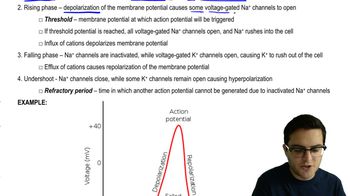
Step 1: Initiation of Action Potential - The process begins in the motor cortex of the brain where an action potential (electrical signal) is generated. This signal travels down the motor neuron towards the neuromuscular junction, which is the synapse between a motor neuron and a muscle fiber.
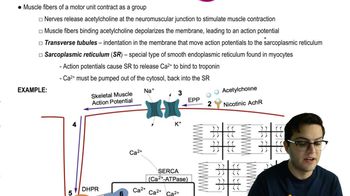
Step 2: Neurotransmitter Release - When the action potential reaches the neuromuscular junction, it triggers the release of the neurotransmitter acetylcholine (ACh) into the synaptic cleft (the gap between the neuron and muscle fiber).
Step 3: Muscle Fiber Depolarization - Acetylcholine binds to receptors on the muscle fiber's membrane, causing ion channels to open and sodium ions to rush into the muscle cell. This influx of sodium ions depolarizes the muscle membrane, creating an action potential in the muscle fiber.
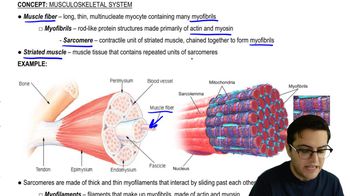
Step 4: Calcium Release and Muscle Contraction - The action potential in the muscle fiber triggers the release of calcium ions from the sarcoplasmic reticulum (a specialized organelle in muscle cells). Calcium binds to troponin, a regulatory protein on the thin filaments of the muscle, causing a conformational change that allows myosin (thick filament) to bind to actin (thin filament) and initiate contraction through the sliding filament mechanism.
Step 5: Differences in Contraction Strength - The strength of a muscle contraction can vary. A strong contraction involves the simultaneous activation of multiple motor units (a motor neuron and the muscle fibers it controls) and a high frequency of action potentials. A weak contraction involves fewer motor units and a lower frequency of action potentials. The amount of calcium released and the sensitivity of the muscle fibers to calcium also play roles in determining the strength of the contraction.

Verified video answer for a similar problem:

This video solution was recommended by our tutors as helpful for the problem above.
Video duration:
1m
Was this helpful?

Key Concepts

Here are the essential concepts you must grasp in order to answer the question correctly.

Action Potentials

Action potentials are rapid electrical signals that travel along neurons. They are initiated when a neuron reaches a certain threshold, causing sodium channels to open and depolarize the membrane. This depolarization propagates along the axon, ultimately leading to the release of neurotransmitters at the neuromuscular junction, which is crucial for muscle contraction.
Recommended video:
Guided course
09:55
Action Potential

Neuromuscular Junction

The neuromuscular junction is the synapse between a motor neuron and a muscle fiber. When action potentials reach this junction, they trigger the release of acetylcholine, a neurotransmitter that binds to receptors on the muscle cell membrane. This binding initiates a series of events that lead to muscle contraction, including the release of calcium ions from the sarcoplasmic reticulum.
Recommended video:
Guided course
03:14
Motor Unit and Neuromuscular Junction

Muscle Contraction Strength

The strength of muscle contraction is influenced by the frequency of action potentials and the number of motor units recruited. A strong contraction occurs when multiple motor units are activated simultaneously, leading to a greater force. In contrast, a weak contraction results from fewer motor units being recruited or lower frequency stimulation, resulting in less force generated by the muscle fibers.
Recommended video:
Guided course
02:40
Muscle Fibers and Sarcomeres
Related Practice
Textbook Question
In terms of both numbers of species and numbers of individuals, insects are the most successful land animals. Write a paragraph explaining how their exoskeletons help them live on land. Are there any disadvantages to having an exoskeleton?
1152
views
Textbook Question
An owl swoops down, seizes a mouse in its talons, and flies back to its perch. Explain how its wings enable it to overcome the downward pull of gravity as it flies upward.
789
views
Textbook Question
The greatest concentration of thoroughbred horse farms is in the bluegrass region of Kentucky. The grass in the limestone-based soil of this area is especially rich in calcium. How does this grass affect the development of championship horses?
629
views
Textbook Question
Using examples, explain this statement: 'Vertebrate skeletons are variations on a theme.'
1075
views
Textbook Question

Drugs are often used to relax muscles during surgery.

Which of the following chemicals do you think would make a better muscle relaxant, and why?

Chemical A: Blocks acetylcholine receptors on muscle cells.

Chemical B: Floods the cytoplasm of muscle cells with calcium ions.

1019
views
Textbook Question
An earthworm's body consists of a number of fluid-filled compartments, each with its own set of longitudinal and circular muscles. But in the roundworm, a single fluid-filled cavity occupies the body, and there are only longitudinal muscles that run its entire length. Predict how the movement of a roundworm would differ from the movement of an earthworm.
872
views