Pearson+ LogoPearson+ Logo
Ch. 30 How Animals Move
Taylor - Campbell Biology: Concepts & Connections 10th Edition
Taylor, Simon, Dickey, Hogan10th EditionCampbell Biology: Concepts & ConnectionsISBN: 9780136538783Not the one you use?Change textbook
Chapter 30, Problem 17

An earthworm's body consists of a number of fluid-filled compartments, each with its own set of longitudinal and circular muscles. But in the roundworm, a single fluid-filled cavity occupies the body, and there are only longitudinal muscles that run its entire length. Predict how the movement of a roundworm would differ from the movement of an earthworm.

Verified step by step guidance
1
Understand the anatomical differences: Recognize that earthworms have both longitudinal and circular muscles in each segment, while roundworms have only longitudinal muscles along the body.
Consider the role of muscle types: Longitudinal muscles generally contract the body, making it shorter and thicker, whereas circular muscles can elongate and thin the body when they contract.
Analyze the impact of muscle arrangement on movement: In earthworms, the combination of longitudinal and circular muscles allows for more versatile movements such as elongating, shortening, and bending in various directions.
Predict roundworm movement: Since roundworms lack circular muscles, their movement would primarily involve shortening and lengthening along their length, without the ability to significantly widen or narrow their body.
Compare movement capabilities: Conclude that earthworms likely have more complex and varied movement capabilities compared to roundworms, who may exhibit simpler and more restricted movement patterns.

Verified video answer for a similar problem:

This video solution was recommended by our tutors as helpful for the problem above.
Video duration:
54s
Was this helpful?

Key Concepts

Here are the essential concepts you must grasp in order to answer the question correctly.

Body Structure and Muscle Arrangement

Earthworms have a segmented body structure with multiple fluid-filled compartments, allowing for localized muscle contraction. Each segment can move independently due to the presence of both longitudinal and circular muscles, facilitating complex movements. In contrast, roundworms possess a more simplified body plan with a single fluid-filled cavity and only longitudinal muscles, which limits their movement to a more uniform, wave-like motion.
Recommended video:
Guided course
02:40
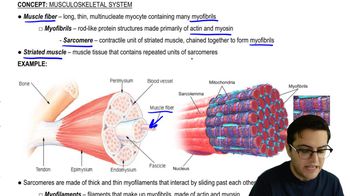
Muscle Fibers and Sarcomeres

Hydrostatic Skeleton

Both earthworms and roundworms utilize a hydrostatic skeleton, where fluid pressure within their body cavities provides structural support. In earthworms, the segmented compartments allow for greater control and flexibility, enabling them to push against the soil and navigate through it. Roundworms, with their single cavity, rely on the pressure of the fluid to create a more rigid body, resulting in less maneuverability and a different style of locomotion.
Recommended video:
Guided course
02:08
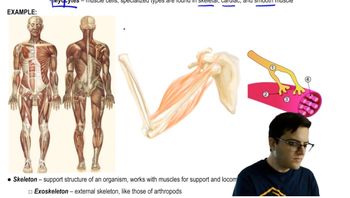
Muscle System and Skeleton

Locomotion Mechanisms

The movement of earthworms involves a combination of contraction and relaxation of both longitudinal and circular muscles, allowing for peristaltic movement and burrowing. This enables them to move through soil effectively. Roundworms, however, primarily use the contraction of longitudinal muscles to create a sinusoidal motion, which is less effective for burrowing but allows for rapid movement through their aquatic or moist environments.
Recommended video:
Guided course
03:04
Prey Defense Mechanisms