Pearson+ LogoPearson+ Logo
Ch. 30 How Animals Move
Taylor - Campbell Biology: Concepts & Connections 10th Edition
Taylor, Simon, Dickey, Hogan10th EditionCampbell Biology: Concepts & ConnectionsISBN: 9780136538783Not the one you use?Change textbook
Chapter 30, Problem 7

When a dog is running fast, its body position is stabilized by
a. Side-to-side undulation
b. Energy stored in tendons
c. Foot contact with the ground
d. Its momentum

Verified step by step guidance
1
Understand the context of the question: The problem is asking about the mechanism that helps stabilize a dog's body position when it is running fast. This involves understanding biomechanics and how animals maintain stability during rapid movement.
Analyze the options provided: Each option represents a potential mechanism. For example, side-to-side undulation (a) refers to lateral body movements, energy stored in tendons (b) relates to elastic energy, foot contact with the ground (c) involves physical interaction with the surface, and momentum (d) refers to the forward motion of the body.
Recall relevant biological concepts: Dogs, like many animals, use a combination of biomechanical strategies to stabilize their movement. Tendons can store and release elastic energy, which helps in efficient locomotion. Momentum contributes to forward motion but does not directly stabilize the body. Foot contact with the ground provides stability and traction, while side-to-side undulation is more common in animals like snakes or fish.
Evaluate the most likely answer: Consider which mechanism is most directly responsible for stabilizing the body during fast running. Tendons storing energy (b) is more about energy efficiency, while foot contact with the ground (c) is crucial for stability. Momentum (d) helps maintain motion but does not stabilize the body position. Side-to-side undulation (a) is not typical for dogs.
Conclude the reasoning process: Based on the analysis, the stabilization of a dog's body position during fast running is most likely due to foot contact with the ground, as it provides the necessary traction and balance to maintain stability.

Verified video answer for a similar problem:

This video solution was recommended by our tutors as helpful for the problem above.
Video duration:
1m
Was this helpful?

Key Concepts

Here are the essential concepts you must grasp in order to answer the question correctly.

Momentum

Momentum is the product of an object's mass and its velocity, representing the quantity of motion an object has. In the context of a running dog, momentum helps maintain stability as it moves quickly, allowing it to resist changes in its motion and direction. A dog with greater momentum can better navigate turns and maintain balance while running.

Tendon Elasticity

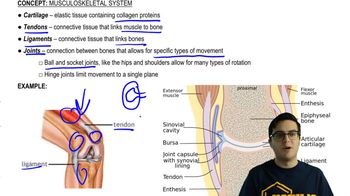
Tendons connect muscles to bones and can store elastic energy when stretched. During running, a dog's tendons absorb energy during the landing phase and release it during the push-off phase, aiding in propulsion and stability. This elastic energy contributes to efficient movement and helps stabilize the dog's body position.
Recommended video:

Foot Contact Dynamics

Foot contact with the ground is crucial for stability and balance during running. The timing and placement of each foot's contact point affect how a dog maintains its posture and direction. Proper foot placement allows for effective force transfer and helps the dog adjust its body position dynamically while in motion.
Recommended video:
Guided course
03:37
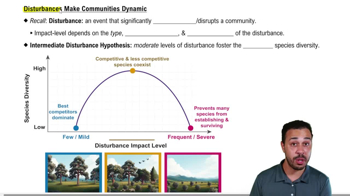
Disturbances Make Communities Dynamic
Related Practice
Textbook Question

Gravity would have the least effect on the movement of which of the following? (Explain your answer.)

a. A salmon

b. A snake

c. A sparrow

d. A grasshopper

844
views
Textbook Question

Which of the following bones in the human arm corresponds to the femur in the leg?

a. Radius

b. Tibia

c. Humerus

d. Metacarpal

1200
views
Textbook Question

Which of the following animals is correctly matched with its type of skeleton?

a. Fly—endoskeleton

b. Earthworm—exoskeleton

c. Lobster—exoskeleton

d. Bee—hydrostatic skeleton

1315
views
Textbook Question

What is the role of calcium in muscle contraction?

a. Its binding to a regulatory protein causes the protein to move, exposing actin binding sites to the myosin heads.

b. It provides energy for contraction.

c. It blocks contraction when the muscle relaxes.

d. It forms the heads of the myosin molecules in the thick filaments inside a muscle fiber.

2772
views
Textbook Question

Muscle A and muscle B have the same number of fibers, but muscle A is capable of more precise control than muscle B. Which of the following is likely to be true of muscle A? (Explain your answer.)

a. It is controlled by more neurons than muscle B

b. It contains fewer motor units than muscle B

c. It is controlled by fewer neurons than muscle B

d. It has larger sarcomeres than muscle B

845
views
Textbook Question

Which of the following statements about skeletons is true?

a. Chitin is a major component of vertebrate skeletons.

b. Loss of forelimbs in snakes involved little change in the axial skeleton.

c. Most cnidarians must shed their skeleton periodically to grow.

d. Vertebrate bones contain living cells.

899
views