Pearson+ LogoPearson+ Logo
Ch. 30 How Animals Move
Taylor - Campbell Biology: Concepts & Connections 10th Edition
Taylor, Simon, Dickey, Hogan10th EditionCampbell Biology: Concepts & ConnectionsISBN: 9780136538783Not the one you use?Change textbook
Chapter 30, Problem 9

Muscle A and muscle B have the same number of fibers, but muscle A is capable of more precise control than muscle B. Which of the following is likely to be true of muscle A? (Explain your answer.)
a. It is controlled by more neurons than muscle B
b. It contains fewer motor units than muscle B
c. It is controlled by fewer neurons than muscle B
d. It has larger sarcomeres than muscle B

Verified step by step guidance
1
Understand the concept of motor units: A motor unit consists of a single motor neuron and all the muscle fibers it controls. Precision in muscle control is achieved when each motor neuron controls fewer muscle fibers, allowing finer adjustments.
Analyze the relationship between motor units and precision: Muscles capable of more precise control typically have more motor units, meaning more neurons control smaller groups of muscle fibers. This allows for finer control of movement.
Evaluate the options: Option (a) suggests muscle A is controlled by more neurons, which aligns with the idea that more motor units lead to greater precision. Option (b) suggests fewer motor units, which would reduce precision. Option (c) suggests fewer neurons, which contradicts the need for more motor units for precision. Option (d) mentions larger sarcomeres, which are unrelated to precision control.
Eliminate incorrect options: Based on the explanation, options (b), (c), and (d) can be ruled out because they do not support the idea of increased precision in muscle control.
Conclude the correct answer: The most likely explanation is that muscle A is controlled by more neurons than muscle B, as this allows for more motor units and finer control.

Verified video answer for a similar problem:

This video solution was recommended by our tutors as helpful for the problem above.
Video duration:
1m
Was this helpful?

Key Concepts

Here are the essential concepts you must grasp in order to answer the question correctly.

Motor Units

A motor unit consists of a single motor neuron and all the muscle fibers it innervates. Muscles that require precise control, such as those involved in fine motor skills, typically have smaller motor units, allowing for more refined movements. In contrast, muscles that perform gross movements have larger motor units, which can control more fibers but with less precision.
Recommended video:
Guided course
03:14
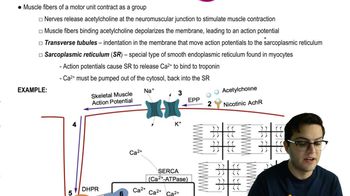
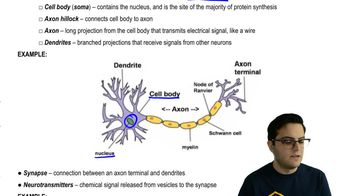
Motor Unit and Neuromuscular Junction

Neuron Control

The number of neurons controlling a muscle affects its precision of movement. More neurons can lead to more motor units, which allows for finer control over muscle contractions. This is particularly important in muscles that perform delicate tasks, where precise adjustments are necessary for effective function.
Recommended video:

Sarcomere Structure

Sarcomeres are the basic contractile units of muscle fibers, composed of actin and myosin filaments. While the size of sarcomeres can influence muscle contraction strength, it does not directly relate to the precision of control. Therefore, larger sarcomeres are not necessarily indicative of a muscle's ability to perform precise movements.
Recommended video:
Guided course
02:40
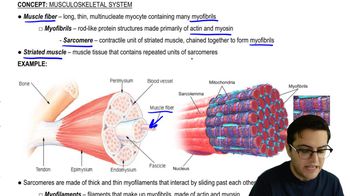
Muscle Fibers and Sarcomeres
Related Practice
Textbook Question

Which of the following animals is correctly matched with its type of skeleton?

a. Fly—endoskeleton

b. Earthworm—exoskeleton

c. Lobster—exoskeleton

d. Bee—hydrostatic skeleton

1315
views
Textbook Question

When a dog is running fast, its body position is stabilized by

a. Side-to-side undulation

b. Energy stored in tendons

c. Foot contact with the ground

d. Its momentum

875
views
Textbook Question

What is the role of calcium in muscle contraction?

a. Its binding to a regulatory protein causes the protein to move, exposing actin binding sites to the myosin heads.

b. It provides energy for contraction.

c. It blocks contraction when the muscle relaxes.

d. It forms the heads of the myosin molecules in the thick filaments inside a muscle fiber.

2772
views
Textbook Question

Which of the following statements about skeletons is true?

a. Chitin is a major component of vertebrate skeletons.

b. Loss of forelimbs in snakes involved little change in the axial skeleton.

c. Most cnidarians must shed their skeleton periodically to grow.

d. Vertebrate bones contain living cells.

899
views
Textbook Question
In terms of both numbers of species and numbers of individuals, insects are the most successful land animals. Write a paragraph explaining how their exoskeletons help them live on land. Are there any disadvantages to having an exoskeleton?
1152
views
Textbook Question
An owl swoops down, seizes a mouse in its talons, and flies back to its perch. Explain how its wings enable it to overcome the downward pull of gravity as it flies upward.
789
views