Pearson+ LogoPearson+ Logo
Ch. 30 How Animals Move
Taylor - Campbell Biology: Concepts & Connections 10th Edition
Taylor, Simon, Dickey, Hogan10th EditionCampbell Biology: Concepts & ConnectionsISBN: 9780136538783Not the one you use?Change textbook
Chapter 30, Problem 10

Which of the following statements about skeletons is true?
a. Chitin is a major component of vertebrate skeletons.
b. Loss of forelimbs in snakes involved little change in the axial skeleton.
c. Most cnidarians must shed their skeleton periodically to grow.
d. Vertebrate bones contain living cells.

Verified step by step guidance
1
Step 1: Understand the question and identify the key terms. The question is asking which statement about skeletons is true. Key terms include 'chitin,' 'vertebrate skeletons,' 'axial skeleton,' 'cnidarians,' and 'vertebrate bones.'
Step 2: Analyze each statement individually. For statement (a), recall that chitin is a polysaccharide found in the exoskeletons of arthropods and fungi, not in vertebrate skeletons, which are primarily composed of calcium phosphate and collagen.
Step 3: For statement (b), consider the anatomy of snakes. The loss of forelimbs in snakes involved significant changes in the axial skeleton, as their body structure is highly adapted for limbless locomotion. This makes the statement incorrect.
Step 4: For statement (c), review the biology of cnidarians. Most cnidarians, such as jellyfish and corals, do not have skeletons that they shed periodically. Instead, corals have calcium carbonate exoskeletons, and jellyfish have hydrostatic skeletons. This makes the statement incorrect.
Step 5: For statement (d), recall that vertebrate bones are living tissues that contain living cells, such as osteocytes, osteoblasts, and osteoclasts. This is a true statement, as bones are dynamic structures involved in growth, repair, and mineral storage.

Verified video answer for a similar problem:

This video solution was recommended by our tutors as helpful for the problem above.
Video duration:
1m
Was this helpful?

Key Concepts

Here are the essential concepts you must grasp in order to answer the question correctly.

Types of Skeletons

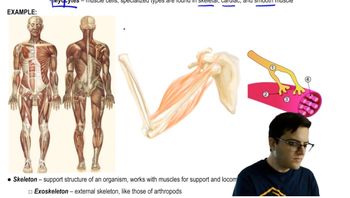
Skeletons can be classified into two main types: exoskeletons and endoskeletons. Exoskeletons, like those found in arthropods, are external structures made of materials such as chitin. In contrast, endoskeletons, which are characteristic of vertebrates, are internal structures made primarily of bone and cartilage, providing support and protection for internal organs.
Recommended video:
Guided course
02:08
Muscle System and Skeleton

Bone Composition

Vertebrate bones are complex structures that contain living cells, including osteocytes, osteoblasts, and osteoclasts. These cells are involved in the growth, maintenance, and remodeling of bone tissue. Additionally, bones are composed of a matrix of collagen fibers and mineral deposits, primarily hydroxyapatite, which provide strength and rigidity.
Recommended video:
Guided course
06:13
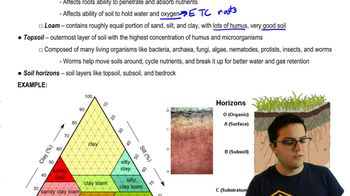
Soil Composition

Skeletal Adaptations in Evolution

The evolution of skeletal structures reflects adaptations to different environments and lifestyles. For example, the loss of forelimbs in snakes is an adaptation to a burrowing or slithering lifestyle, which has resulted in minimal changes to the axial skeleton. Understanding these adaptations helps explain the diversity of skeletal forms across different species.
Recommended video:
05:24
Adaptive Radiation
Related Practice
Textbook Question

When a dog is running fast, its body position is stabilized by

a. Side-to-side undulation

b. Energy stored in tendons

c. Foot contact with the ground

d. Its momentum

875
views
Textbook Question

What is the role of calcium in muscle contraction?

a. Its binding to a regulatory protein causes the protein to move, exposing actin binding sites to the myosin heads.

b. It provides energy for contraction.

c. It blocks contraction when the muscle relaxes.

d. It forms the heads of the myosin molecules in the thick filaments inside a muscle fiber.

2772
views
Textbook Question

Muscle A and muscle B have the same number of fibers, but muscle A is capable of more precise control than muscle B. Which of the following is likely to be true of muscle A? (Explain your answer.)

a. It is controlled by more neurons than muscle B

b. It contains fewer motor units than muscle B

c. It is controlled by fewer neurons than muscle B

d. It has larger sarcomeres than muscle B

845
views
Textbook Question
In terms of both numbers of species and numbers of individuals, insects are the most successful land animals. Write a paragraph explaining how their exoskeletons help them live on land. Are there any disadvantages to having an exoskeleton?
1152
views
Textbook Question
An owl swoops down, seizes a mouse in its talons, and flies back to its perch. Explain how its wings enable it to overcome the downward pull of gravity as it flies upward.
789
views
Textbook Question
The greatest concentration of thoroughbred horse farms is in the bluegrass region of Kentucky. The grass in the limestone-based soil of this area is especially rich in calcium. How does this grass affect the development of championship horses?
629
views