Pearson+ LogoPearson+ Logo
Ch. 30 How Animals Move
Taylor - Campbell Biology: Concepts & Connections 10th Edition
Taylor, Simon, Dickey, Hogan10th EditionCampbell Biology: Concepts & ConnectionsISBN: 9780136538783Not the one you use?Change textbook
Chapter 30, Problem 8

What is the role of calcium in muscle contraction?
a. Its binding to a regulatory protein causes the protein to move, exposing actin binding sites to the myosin heads.
b. It provides energy for contraction.
c. It blocks contraction when the muscle relaxes.
d. It forms the heads of the myosin molecules in the thick filaments inside a muscle fiber.

Verified step by step guidance
1
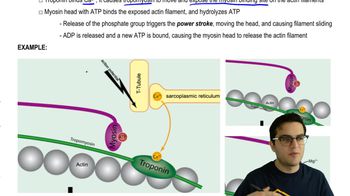
Understand the process of muscle contraction: Muscle contraction is regulated by the interaction between actin and myosin filaments, which is controlled by calcium ions (Ca²⁺) and regulatory proteins such as troponin and tropomyosin.
Recall the role of calcium ions (Ca²⁺): Calcium ions are released from the sarcoplasmic reticulum in response to a nerve signal. These ions play a critical role in initiating muscle contraction.
Identify the interaction between calcium and regulatory proteins: Calcium binds to the protein troponin, which is part of the regulatory complex on the actin filament. This binding causes a conformational change in troponin.
Explain how this conformational change affects tropomyosin: The conformational change in troponin moves tropomyosin, another regulatory protein, away from the binding sites on actin. This exposes the actin binding sites to the myosin heads, allowing cross-bridge formation and muscle contraction to occur.
Match the correct option: Based on the explanation, the correct answer is the one that describes calcium's role in exposing actin binding sites to myosin heads by interacting with a regulatory protein.

Verified video answer for a similar problem:

This video solution was recommended by our tutors as helpful for the problem above.
Video duration:
1m
Was this helpful?

Key Concepts

Here are the essential concepts you must grasp in order to answer the question correctly.

Calcium's Role in Muscle Contraction

Calcium ions are crucial for muscle contraction as they bind to troponin, a regulatory protein on the actin filaments. This binding causes a conformational change that moves tropomyosin away from the actin binding sites, allowing myosin heads to attach and initiate contraction. Without calcium, muscle fibers cannot contract effectively.
Recommended video:
Guided course
02:40
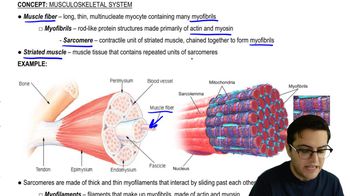
Muscle Fibers and Sarcomeres

Sliding Filament Theory

The sliding filament theory explains how muscle contraction occurs through the sliding of actin and myosin filaments past each other. When myosin heads bind to actin, they pull the actin filaments inward, shortening the muscle fiber. This process is powered by ATP, which is necessary for the myosin heads to detach and reattach during contraction cycles.
Recommended video:
Guided course
04:30
Sliding Filament Model

Regulatory Proteins in Muscle Contraction

Regulatory proteins, such as troponin and tropomyosin, play a vital role in controlling muscle contraction. Troponin binds calcium, leading to a shift in tropomyosin that uncovers binding sites on actin. This regulation ensures that muscle contraction occurs only when calcium is present, allowing for precise control of muscle activity.
Recommended video:
Related Practice
Textbook Question

Which of the following bones in the human arm corresponds to the femur in the leg?

a. Radius

b. Tibia

c. Humerus

d. Metacarpal

1200
views
Textbook Question

Which of the following animals is correctly matched with its type of skeleton?

a. Fly—endoskeleton

b. Earthworm—exoskeleton

c. Lobster—exoskeleton

d. Bee—hydrostatic skeleton

1315
views
Textbook Question

When a dog is running fast, its body position is stabilized by

a. Side-to-side undulation

b. Energy stored in tendons

c. Foot contact with the ground

d. Its momentum

875
views
Textbook Question

Muscle A and muscle B have the same number of fibers, but muscle A is capable of more precise control than muscle B. Which of the following is likely to be true of muscle A? (Explain your answer.)

a. It is controlled by more neurons than muscle B

b. It contains fewer motor units than muscle B

c. It is controlled by fewer neurons than muscle B

d. It has larger sarcomeres than muscle B

845
views
Textbook Question

Which of the following statements about skeletons is true?

a. Chitin is a major component of vertebrate skeletons.

b. Loss of forelimbs in snakes involved little change in the axial skeleton.

c. Most cnidarians must shed their skeleton periodically to grow.

d. Vertebrate bones contain living cells.

899
views
Textbook Question
In terms of both numbers of species and numbers of individuals, insects are the most successful land animals. Write a paragraph explaining how their exoskeletons help them live on land. Are there any disadvantages to having an exoskeleton?
1152
views