Pearson+ LogoPearson+ Logo
Ch. 2 The Chemical Basis of Life
Taylor - Campbell Biology: Concepts & Connections 10th Edition
Taylor, Simon, Dickey, Hogan10th EditionCampbell Biology: Concepts & ConnectionsISBN: 9780136538783Not the one you use?Change textbook
Chapter 2, Problem 16

In agricultural areas, farmers pay close attention to the weather forecast. Right before a predicted overnight freeze, farmers spray water on crops to protect the plants. Use the properties of water to explain how this method works. Be sure to mention why hydrogen bonds are responsible for this phenomenon.

Verified step by step guidance
1
Understand the unique properties of water, particularly its high specific heat capacity and heat of fusion. Water's high specific heat capacity means it can absorb a lot of heat before it changes temperature, and its high heat of fusion means it requires a lot of energy to change from liquid to solid (freeze).
Recognize that when water is sprayed on the crops and it begins to freeze, the process of freezing actually releases heat into the surrounding environment. This released heat is known as the latent heat of fusion.
Acknowledge that the heat released during the freezing process helps to keep the plants and the surrounding air slightly warmer than they would be otherwise, which can protect the plants from damage due to freezing temperatures.
Explain the role of hydrogen bonds in water's properties. Hydrogen bonds make ice less dense than liquid water and contribute to the high specific heat and heat of fusion. These bonds require a lot of energy to break, which is why water releases a significant amount of heat when it freezes.
Summarize how the application of water before a freeze can create a protective ice layer that insulates the plant, slowing down the loss of heat from the plant to the environment and preventing internal temperatures of the plants from dropping too low, thus avoiding frost damage.

Verified video answer for a similar problem:

This video solution was recommended by our tutors as helpful for the problem above.
Video duration:
2m
Was this helpful?

Key Concepts

Here are the essential concepts you must grasp in order to answer the question correctly.

Properties of Water

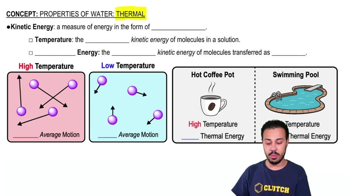
Water has unique properties, including high specific heat, cohesion, and the ability to exist in three states. These properties arise from its molecular structure and hydrogen bonding. When water freezes, it expands, which is crucial for protecting crops during a freeze, as the water forms a protective layer that insulates the plants.
Recommended video:
Guided course
04:07
Properties of Water- Thermal

Hydrogen Bonds

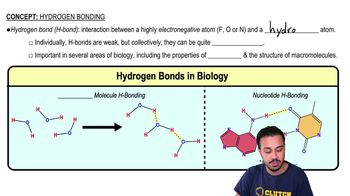
Hydrogen bonds are weak attractions between the hydrogen atom of one water molecule and the oxygen atom of another. These bonds are responsible for many of water's unique properties, including its high heat capacity and surface tension. In the context of freezing, hydrogen bonds help maintain the structure of ice, which is less dense than liquid water, allowing it to float and provide insulation.
Recommended video:
Guided course
05:03
Hydrogen Bonding

Freezing and Insulation

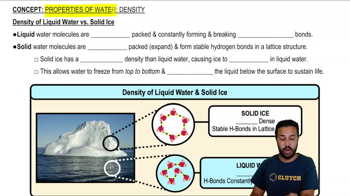
When water is sprayed on crops before a freeze, it forms a layer of ice as temperatures drop. This ice layer acts as an insulator, slowing down the rate of heat loss from the plants. The heat released during the freezing process helps to keep the temperature of the crops above freezing, thereby protecting them from frost damage.
Recommended video:
Guided course
05:43
Density of Liquid Water vs. Solid Ice
Related Practice
Textbook Question
Look back at the abbreviated periodic table of the elements in Figure 2.5B. If two elements are in the same row, what do they have in common? If two elements are in the same column, what do they have in common? Would you predict that elements in the same row or the same column will have similar chemical properties? Explain.

1911
views
Textbook Question
What do you think the effect on the properties of water would be if oxygen and hydrogen had equal electronegativity?
1206
views
Textbook Question

A recent experimental study looked at the combined effects of ocean acidification and increased ocean temperatures, both aspects of climate change, on the growth of polyps, juvenile coral animals. Researchers reported the average polyp biomass (in μg/polyp) after 42 days of growth under four treatments: a control with pH and temperature maintained close to normal reef conditions, a pH lowered by 0.2 units, a temperature raised by 1°C, and a combined lower pH and higher temperature. The results showed that polyp biomass was reduced somewhat in both the low-pH and high-temperature treatments, but the combined treatment resulted in a reduction in growth by almost a third—a statistically significant result. Experiments often look at the effects of changing one variable at a time while keeping all other variables constant.

Explain why this experiment considered two variables—both a higher temperature and a lower pH—at the same time.

1463
views
Textbook Question

This chapter explains how the emergent properties of water contribute to the suitability of the environment for life. Until fairly recently, scientists assumed that other physical requirements for life included a moderate range of temperature, pH, and atmospheric pressure. That view has changed with the discovery of organisms known as extremophiles, which have been found flourishing in hot, acidic sulfur springs and around hydrothermal vents deep in the ocean.

What does the existence of life in such environments say about the possibility of life on other planets?

1718
views