
Textbook Question
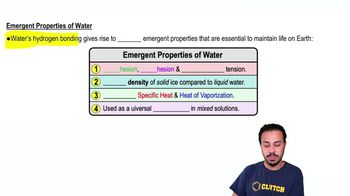
What do you think the effect on the properties of water would be if oxygen and hydrogen had equal electronegativity?
1206
views


 Verified step by step guidance
 01:29
01:29
 04:39
04:39A recent experimental study looked at the combined effects of ocean acidification and increased ocean temperatures, both aspects of climate change, on the growth of polyps, juvenile coral animals. Researchers reported the average polyp biomass (in μg/polyp) after 42 days of growth under four treatments: a control with pH and temperature maintained close to normal reef conditions, a pH lowered by 0.2 units, a temperature raised by 1°C, and a combined lower pH and higher temperature. The results showed that polyp biomass was reduced somewhat in both the low-pH and high-temperature treatments, but the combined treatment resulted in a reduction in growth by almost a third—a statistically significant result. Experiments often look at the effects of changing one variable at a time while keeping all other variables constant.
Explain why this experiment considered two variables—both a higher temperature and a lower pH—at the same time.