
Pearson+ LogoPearson+ Logo
Ch. 2 The Chemical Basis of Life
Taylor - Campbell Biology: Concepts & Connections 10th Edition
Taylor, Simon, Dickey, Hogan10th EditionCampbell Biology: Concepts & ConnectionsISBN: 9780136538783Not the one you use?Change textbook
Chapter 2, Problem 11

In terms of electron sharing between atoms, compare nonpolar covalent bonds, polar covalent bonds, and ions.
Diagram illustrating nonpolar and polar covalent bonds and ionic bonds in atoms.

Verified step by step guidance
1
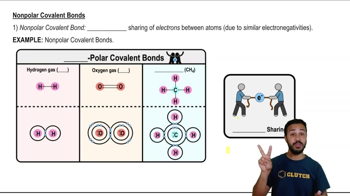
Nonpolar covalent bonds involve equal sharing of electrons between two atoms, typically of the same or similar electronegativity. For example, in a molecule like O₂, both oxygen atoms share electrons equally because their electronegativities are identical.
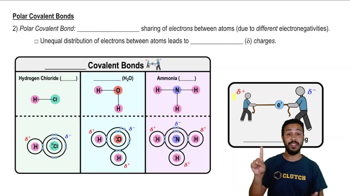
Polar covalent bonds involve unequal sharing of electrons between two atoms due to a difference in electronegativity. The atom with higher electronegativity attracts the shared electrons more strongly, creating a partial negative charge on that atom and a partial positive charge on the other. For instance, in H₂O, oxygen is more electronegative than hydrogen, so the shared electrons are closer to oxygen.
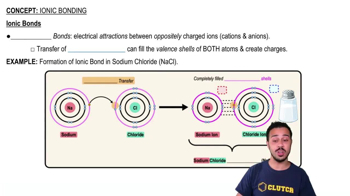
Ions are formed when atoms either lose or gain electrons completely, rather than sharing them. This results in charged particles: cations (positively charged ions) form when electrons are lost, and anions (negatively charged ions) form when electrons are gained. For example, Na⁺ and Cl⁻ are ions formed in the ionic bond of NaCl.
The key difference between covalent bonds and ions is that covalent bonds involve sharing electrons (either equally or unequally), while ions result from the complete transfer of electrons between atoms.
In the image provided, the chemical structures likely represent examples of molecules with covalent bonds (polar or nonpolar) or ionic compounds. Analyze the electronegativity differences between the atoms in the structures to determine the type of bond present.

Verified video answer for a similar problem:

This video solution was recommended by our tutors as helpful for the problem above.
Video duration:
3m
Was this helpful?

Key Concepts

Here are the essential concepts you must grasp in order to answer the question correctly.

Nonpolar Covalent Bonds

Nonpolar covalent bonds occur when two atoms share electrons equally due to similar electronegativities. This equal sharing results in a balanced distribution of electrical charge, meaning there is no significant dipole moment. Common examples include bonds between identical atoms, such as in diatomic molecules like O2 and N2.
Recommended video:
Guided course
06:41
Nonpolar Covalent Bonds

Polar Covalent Bonds

Polar covalent bonds form when two atoms share electrons unequally, leading to a partial positive charge on one atom and a partial negative charge on the other. This occurs when there is a significant difference in electronegativity between the two atoms, such as in water (H2O), where oxygen is more electronegative than hydrogen, creating a dipole moment.
Recommended video:
Guided course
06:59
Polar Covalent Bonds

Ionic Bonds

Ionic bonds arise when one atom donates an electron to another, resulting in the formation of charged ions. The atom that loses an electron becomes a positively charged cation, while the atom that gains an electron becomes a negatively charged anion. The electrostatic attraction between these oppositely charged ions forms a strong ionic bond, as seen in compounds like sodium chloride (NaCl).
Recommended video: