Pearson+ LogoPearson+ Logo
Ch. 2 The Chemical Basis of Life
Taylor - Campbell Biology: Concepts & Connections 10th Edition
Taylor, Simon, Dickey, Hogan10th EditionCampbell Biology: Concepts & ConnectionsISBN: 9780136538783Not the one you use?Change textbook
Chapter 2, Problem 8

The atomic number of sulfur (S) is 16. Sulfur combines with hydrogen by covalent bonding to form a compound, hydrogen sulfide. Based on the number of valence electrons in a sulfur atom, predict the molecular formula of the compound. (Explain your answer.)
a. HS
b. H₂S
c. H₄S₂
d. H₄S

Verified step by step guidance
1
Determine the number of valence electrons in a sulfur (S) atom. Sulfur has an atomic number of 16, meaning it has 16 electrons. The electron configuration is 1s² 2s² 2p⁶ 3s² 3p⁴, so sulfur has 6 valence electrons in its outermost shell (3s² 3p⁴).
Understand that sulfur needs 8 electrons in its valence shell to satisfy the octet rule. Since it has 6 valence electrons, it needs 2 more electrons to complete its octet.
Hydrogen (H) has 1 valence electron and can form 1 covalent bond by sharing its electron. Each hydrogen atom can share its electron with sulfur to help sulfur complete its octet.
Predict the molecular formula by determining how many hydrogen atoms are needed. Since sulfur needs 2 additional electrons, it will form 2 covalent bonds with 2 hydrogen atoms, resulting in the molecular formula H₂S.
Verify the molecular formula by checking the total number of shared electrons. Sulfur shares 2 electrons with 2 hydrogen atoms, completing its octet, and each hydrogen atom achieves a stable configuration with 2 electrons in its valence shell.

Verified video answer for a similar problem:

This video solution was recommended by our tutors as helpful for the problem above.
Video duration:
1m
Was this helpful?

Key Concepts

Here are the essential concepts you must grasp in order to answer the question correctly.

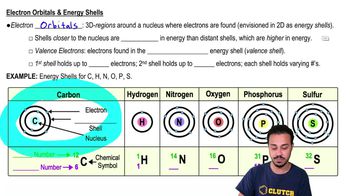
Atomic Number and Valence Electrons

The atomic number of an element indicates the number of protons in its nucleus, which also equals the number of electrons in a neutral atom. For sulfur (S), with an atomic number of 16, it has six valence electrons in its outer shell. Valence electrons are crucial for determining how an atom will bond with other atoms, particularly in covalent bonding.
Recommended video:
Guided course
09:44
Electron Orbitals & Energy Shells

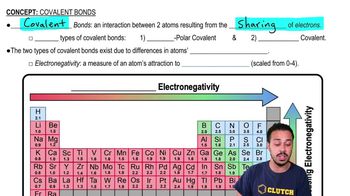
Covalent Bonding

Covalent bonding occurs when two atoms share one or more pairs of electrons to achieve a full outer electron shell, which is typically stable. In the case of hydrogen sulfide (H2S), sulfur shares its valence electrons with two hydrogen atoms, each contributing one electron. This sharing allows both sulfur and hydrogen to attain a more stable electronic configuration.
Recommended video:
Guided course
04:28
Covalent Bonds

Molecular Formula

A molecular formula represents the number and types of atoms in a molecule. For hydrogen sulfide, the molecular formula is H2S, indicating that each molecule consists of two hydrogen atoms and one sulfur atom. Understanding how to derive the molecular formula from the bonding patterns and valence electrons is essential for predicting the correct formula of a compound.
Recommended video:
05:13
The Molecular Clock