
Pearson+ LogoPearson+ Logo
Ch. 6 How Cells Harvest Chemical Energy
Taylor - Campbell Biology: Concepts & Connections 10th Edition
Taylor, Simon, Dickey, Hogan10th EditionCampbell Biology: Concepts & ConnectionsISBN: 9780136538783Not the one you use?Change textbook
Chapter 6, Problem 8

In which of the following is the first molecule becoming reduced to the second molecule?
a. Pyruvate → acetylCoA
b. Pyruvate → lactate
c. Glucose → pyruvate
d. NADH + H+ →NAD+ + 2H

Verified step by step guidance
1
Step 1: Understand the concept of reduction in biological terms. Reduction involves the gain of electrons or hydrogen atoms by a molecule. Conversely, oxidation involves the loss of electrons or hydrogen atoms.
Step 2: Analyze each option to determine whether the first molecule is gaining electrons or hydrogen atoms (reduction) or losing them (oxidation).
Step 3: For option a (pyruvate → acetylCoA), note that pyruvate loses electrons and hydrogen atoms during its conversion to acetylCoA, which is an oxidation process, not reduction.
Step 4: For option b (pyruvate → lactate), observe that pyruvate gains electrons and hydrogen atoms during its conversion to lactate, which is a reduction process.
Step 5: For option d (NADH + H+ → NAD+ + 2H), note that NADH loses electrons and hydrogen atoms, which is an oxidation process, not reduction. Therefore, the correct answer is option b, where pyruvate is reduced to lactate.

Verified video answer for a similar problem:

This video solution was recommended by our tutors as helpful for the problem above.
Video duration:
2m
Was this helpful?

Key Concepts

Here are the essential concepts you must grasp in order to answer the question correctly.

Reduction and Oxidation Reactions

Reduction and oxidation (redox) reactions are chemical processes where electrons are transferred between molecules. Reduction refers to the gain of electrons or hydrogen, while oxidation involves the loss of electrons or hydrogen. Understanding these concepts is crucial for identifying which molecules are being reduced or oxidized in metabolic pathways.
Recommended video:
Guided course
04:38
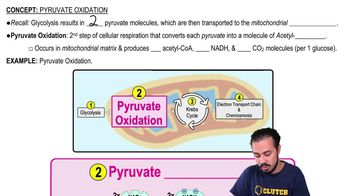
Pyruvate Oxidation

Metabolic Pathways

Metabolic pathways are sequences of chemical reactions occurring within a cell, where specific substrates are converted into products through enzymatic activity. Each step in a pathway can involve oxidation or reduction, and recognizing these pathways helps in understanding how energy is produced and utilized in biological systems.
Recommended video:
Guided course
02:17
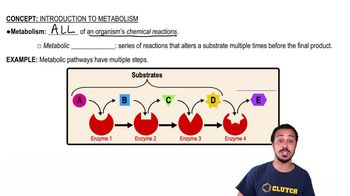
Introduction to Metabolism

Role of NADH and NAD+

NADH and NAD+ are key coenzymes in cellular metabolism, particularly in redox reactions. NAD+ acts as an electron acceptor, becoming reduced to NADH, while NADH can be oxidized back to NAD+. This interconversion is vital for energy production in processes like cellular respiration and fermentation.
Recommended video:
Guided course
05:22
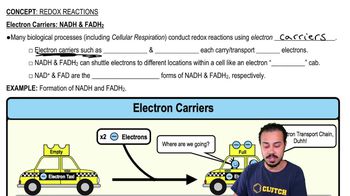
Electron Carriers: NADH & FADH2
Related Practice
Textbook Question

Which of the following is the most immediate source of energy for making most of the ATP in your cells?

a. The transfer of from intermediate substrates to ADP

b. The movement of H⁺ across a membrane down its concentration gradient

c. The splitting of glucose into two molecules of pyruvate

d. Electrons moving through the electron transport chain

1532
views
Textbook Question

Which of the following is a distinction between cellular respiration and fermentation?

a. The transfer of from intermediate substrates to ADP

b. The movement of H+ across a membrane down its concentration gradient

c. The splitting of glucose into two molecules of pyruvate

d. Electrons moving through the electron transport chain

1287
views
Textbook Question

The poison cyanide binds to an electron carrier within the electron transport chain and blocks the movement of electrons. When this happens, glycolysis and the citric acid cycle soon grind to a halt as well. Why do you think these other two stages of cellular respiration stop? (Explain your answer.)

a. They run out of ATP

b. Unused O₂ interferes with cellular respiration

c. They run out of NAD+ and FAD

d. Electrons are no longer available

6154
views
Textbook Question
Which of the three stages of cellular respiration is considered the most ancient? Explain your answer.
2161
views
Textbook Question
Compare and contrast fermentation as it occurs in your muscle cells and in yeast cells.
1637
views
Textbook Question

Explain how your body can convert excess carbohydrates in the diet to fats.

Can excess carbohydrates be converted to protein?

What else must be supplied?

2155
views